Keywords: water privatization
SOURCE: WIKIPEDIA
Water privatization is used here as a shorthand for private sector participation in the provision of water services and sanitation (the sale of water resources themselves is covered in the article on water trading). Private sector participation in water supply and sanitation is controversial. Proponents of private sector participation argue that it has led to improvements in the efficiency and service quality of utilities. It is argued that it has increased investment and has contributed to expanded access. They cite Manila, Guayaquil in Ecuador, Bucharest, several cities in Colombia and Morocco, as well as Côte d'Ivoire and Senegal as success stories.[1][2][3] Critics however, contend that private sector participation led to tariff increases and has turned a public good into a private good. Many believe that water is an unalienable human right (much like air or light) that cannot be privatized or used for personal profit. They quote the aborted privatizations in Cochamamba, Bolivia, and Dar es-Salaam, Tanzania, as well as the still privately managed water systems in Jakarta and Berlin as failures.[4][5][6][7] Water privatization in Buenos Aires, Argentina and in England is cited by both supporters and opponents, each emphasizing different aspects of these cases. Statistical studies comparing public and private utilities show little difference in performance between them.[8][9][10][11][12]
Even the figures about how many people receive water from the private
sector are controversial: One source claims that 909 million people
were served by "private players" in 2011 globally, up from 681 million
people in 2007. This figure includes people served by publicly owned
companies that have merely sourced out the financing, construction and
operation of part of their assets, such as water or wastewater treatment
plants, to the private sector.[13]
The World Bank estimated the urban population directly served by
private water operators in developing countries to be much lower at 170
million in 2007.[1]
Among them only about 15 million people, all living in Chile, are
served by privately owned utilities. The remainder are served by
privately managed, but publicly owned companies under concession, lease
and management contracts.

 The Hampton water works serving London were part of the assets sold in
1989 as part of the privatization of water supply in England.
Privately owned water utilities were common in Europe, the United
States and Latin America in the mid- and late 19th century. Their
importance gradually faded away until the early 20th century as they
proved unable to expand access and publicly owned utilities became
stronger. A second global dawn of private water utilities came in the
early 1990s in the aftermath of the Thatcher privatizations in England, the fall of communism and the ensuing global emphasis on free market policies. The World Bank and the International Monetary Fund
played an important role in this process through the conditionality of
their lending. However, some water privatizations failed, most notably
in 2000 in Cochabamba, Bolivia, paving the way for a new pragmatism and a reduced emphasis on privatization.
The Hampton water works serving London were part of the assets sold in
1989 as part of the privatization of water supply in England.
Privately owned water utilities were common in Europe, the United
States and Latin America in the mid- and late 19th century. Their
importance gradually faded away until the early 20th century as they
proved unable to expand access and publicly owned utilities became
stronger. A second global dawn of private water utilities came in the
early 1990s in the aftermath of the Thatcher privatizations in England, the fall of communism and the ensuing global emphasis on free market policies. The World Bank and the International Monetary Fund
played an important role in this process through the conditionality of
their lending. However, some water privatizations failed, most notably
in 2000 in Cochabamba, Bolivia, paving the way for a new pragmatism and a reduced emphasis on privatization.
In England and Wales, the emergence of the first private water companies dates back to the 17th century. In 1820, six private water companies operated in London. However, the market share of private water companies in London declined from 40% in 1860 to 10% in 1900. In the 1980s, their share all over England and Wales was about 25%.[14] The tide turned completely in 1989 when the conservative government of Margaret Thatcher privatized all public water and sewer companies in England and Wales. In Scotland local governments dominated by the Labour party kept water systems in public hands.

The water supply of Paris was operated by two private companies from 1984 to 2000, each serving one half of the city.
The water sector in France has always been characterized by a
coexistence of public and private management, with their respective
shares fluctuating over time. The two largest private companies are Veolia Environnement, formerly the Compagnie Générale des Eaux and then Vivendi Environnement, and Suez Environnement,
formerly Lyonnaise des Eaux and then Ondeo. The Compagnie Générale des
Eaux was founded in 1853 and Lyonnaise des Eaux in 1880. In the late
19th century, municipal governments, dissatisfied with high tariffs and
the lack of expansion of networks to poor neighborhoods, did not renew
private concessions and created instead municipally owned utilities. The
share of private water operators declined to 17% in 1936. The share of
the private sector gradually increased to 32% in 1954, 50% in 1975 and
80% in 2000 using a new model: Instead of the concession contracts,
which gave the responsibility to finance investments to the private
company, the new lease contracts (affermages) made the private
operator only responsible for operation and maintenance, while major
investments became a responsibility of the municipalities.[15][16] The French water companies also escaped the nationalizations after the war and later under President François Mitterrand,
because the central government did not want to interfere with the
autonomy of municipalities and was unwilling to finance heavy
investments.[17]
The water supply of Paris was privatized in 1984 when a conservative
mayor awarded two lease contracts, each covering one half of the city.
In 2010, a socialist mayor remunicipalized the water system of the
French capital.
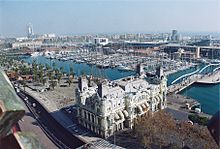
The water supply of Barcelona has been managed by a private company, Aguas de Barcelona, since 1867.
In Spain, private water companies maintained their position, budging
the global trend during the late 19th and early 20th century.[17] The largest private water company in Spain is Aguas de Barcelona.
Initially created by French and Belgian investors, it was sold to
Spanish investors in 1920, only to gradually come back under French
control in the early 21st century.[18]
In Germany, a British private water company had set up the first piped water system and treatment plant in Berlin in 1852, but the city, dissatisfied with the lack of investment in particular in sewerage, cancelled the contract in 1873.[19] In 1887 Gelsenwasser was created, which remains an important regional water supplier in the Ruhr district. The German water sector has always been dominated by municipally owned utilities. Despite this, the water system of Berlin was partially privatized in 1999 for fiscal reasons.
In the United States, 60% of piped water systems were privately owned in 1850. This share declined to 30% in 1924.[20] As of 2010, 2000 water and wastewater facilities in the U.S. were operated under public-private partnerships, a joint effort between the private group and the municipality it was operating in.[21]
European and local private water companies expanded in Latin America, Africa and Asia in the second half of the 19th century, all while their importance declined in Europe. In Uruguay, water supply was privately managed from 1867 to 1950; in Buenos Aires, Argentina, for a brief period from 1887 to 1891 and again from 1993 to 2006; in Cairo and Alexandria, Egypt, from 1867 to 1956; in Beirut, Lebanon, from the 19th century until 1951; in Shanghai, China, from 1875 to 1949; in Casablanca, Morocco, from 1914 to 1962 and then again after 1997; in Senegal until 1971 and then again after 1996; and in Côte d'Ivoire from colonial times until today without interruption.[22]
In Central and Eastern Europe, private companies expanded during the late 1990s, especially in Bulgaria, the Czech Republic, Hungary and Romania.
The three most common forms of PPPs, in the order of increasing responsibilities for the private partner, are:
A concession for the construction of a new plant is called a Build-Operate-Transfer (BOT) contract. Under a BOT contract the private operator signs an agreement with a utility that purchases treated water or wastewater treatment services.

Even the government of Cuba entrusted the water supply of Havana to a
private company in order to improve service quality, showing the
diversity of motives behind water privatization.
The motives for water privatization vary from one case to the other,
and they often determine the choice of the mode of privatization:
Management and lease contracts are used to increase efficiency and
improve service quality, while asset sales and concessions primarily aim
to reduce the fiscal burden or to expand access. Ideological motives
and external influences also play a role. Often several of the above
motives are combined.

Prague is one of many cities whose water supply is provided by a private company
There are widely differing estimates of the number of people served
by private water companies. The World Bank estimated that, as of 2007,
about 270 million people received water from private companies in more
than 40 countries, including about 160 million in developed countries
and 110 million in developing countries. The report did not include
estimates of the number of people served by private companies on the
wastewater side.[1]
The Pinsent Masons Water Yearbook uses a broader definition including
also wastewater services. More importantly, it also includes cases where
a water or wastewater treatment plant is operated by a private company
on behalf of a publicly owned and operated utility that serves the final
customer. On the basis of this broader definition and taking into
account the growth of both population and water privatization between
2007 and 2011, it estimates that 909 million in 62 countries or 13% of
the world population were served by the private sector in one form or
another. This includes 309 million people in China, 61 million in the
United States, 60 million in Brazil, 46 million in France, 23 million in
Spain, 15 million in India and 14 million in Russia.[24]
In England and Wales the entire population of 55 million is served by
private companies. In addition, in Chile, the Czech Republic, Armenia
and four African countries – Côte d'Ivoire, Ghana, Gabon and Senegal –
private companies provide water services to the entire urban population.
In Hungary they serve almost half the population. In Algeria, Colombia,
Germany, Italy, Malaysia, Mexico, Morocco, Poland and South Africa less
than half the population is served by private companies. In the
Philippines, Indonesia, Bulgaria, Estonia and Cuba private water
companies serve only the capital city. 24 countries, such as Argentina,
Bolivia and a number of small countries like Guyana or the Central
African Republic, had reverted to public management as of 2009. However,
84 percent of contracts awarded mostly in the 1990s were still active.[1]
List of countries with formal private sector participation in urban water supply with number and type of contracts
A World Bank report lists the following examples of successful
public-private partnerships in developing countries: the full
privatization in Chile; the mixed companies in Colombia; the concessions in Guayaquil in Ecuador, Brazil, Argentina, Eastern Manila in the Philippines, Morocco and Gabun; and the lease contracts in Côte d'Ivoire, Senegal and Yerevan in Armenia.[1]
In many countries, such as in Japan, Canada, Egypt, Pakistan or Scandinavia, there are no private water companies. Nicaragua, the Netherlands and Uruguay have even passed laws banning water privatization.[33] In Italy, in June 2011 a law favoring water privatization was repealed by an overwhelming majority of Italians through a referendum.[34]
Globally, regulation of private water companies is being carried out by the following types of public entities or, sometimes, a combination of them.
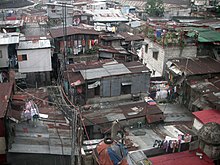
The private companies providing water in Manila have substantially expanded access of water supply to the poor living in slums.
Water privatization in Manila began in 1997 with the award of two concession contracts for the Eastern and Western halves of Metro Manila. The concessions represent the largest population served by private operators in the developing world.[45]
As of 2010, the concession in Eastern Manila is highly successful and
has led to significant improvements in access, service quality and
efficiency: the population served more than doubled from 3 in 1997 to
6.1 million in 2009, the share of customers with continuous water supply
increased from 26% to more than 98% and non-revenue water declined from 63% to 16%.[46]
The concession in Western Manila failed when the company Maynilad went
bankrupt in 2003. It was sold to new investors in 2007 and performance
has improved since then.[47] The share of the population with access to piped water in Western Manila increased from 67% in 1997 to 86% in 2006[48] and the share of customers that enjoys 24-hour water supply increased from 32% in 2007 to 71% in early 2011.[49]

Water supply in Buenos Aires was provided by a private company from 1993 to 2006.
Water privatization in Argentina began in 1992 under the government of Carlos Menem
as part of one of the world's largest privatization programs.
Concessions were signed in 28% of the country's municipalities covering
60% of the population,[50] including in 1993 for the metropolitan area of Buenos Aires. After the 2001 economic crisis, under the government of Néstor Kirchner,
almost all concessions were terminated, including in Buenos Aires in
2006. The impact of the concession remains controversial. The government
and critics argue that the concessionaire failed to achieve the targets
set under the concession contract in terms of expansion of access,
investment and service quality.[51][52]
Proponents concede that targets were not reached, but argue that a
freeze in tariffs at the time of the devaluation of the Peso during the
Argentinian economic crisis in 2001 violated the contract and thus made
it impossible to achieve the original targets. According to the
Argentinian economist Sebastian Galiani, the public company OSN had
invested only US$25m per year between 1983 and 1993, while the private
concessionaire Aguas Argentinas increased investments to around US$200m
per year between 1993 and 2000.[53] According to the private concessionnaire Suez,
during the 13-year-duration of its concession it extended access to
water to 2 million people and access to sanitation to 1 million people,
despite the economic crisis.[54][55] In July 2010 the International Center for the Settlement of Investment Disputes
(ICSID) ruled that the Argentinian government unfairly refused to allow
the private concessionaires to raise tariffs during the period after
the devaluation of the Argentine peso in 2001 and that the private
companies are entitled to damages. The private companies announced that
they would seek US$1.2bn in damages.[56]
In the mid-1990s the government of Bolivia, under pressure from the World Bank, decided to privatize water supply in the country’s third largest city, Cochabamba.
In the previous years, despite encumbered funds made available by the
World Bank to support the public utility of Cochabamba, access to piped
water in the city had decreased to 40%, water losses had remained high
at 40% and water was supplied only 4 hours a day.[57] Those not connected to the network paid ten times as much for their water to private vendors as those who were.[58] This contrasted with the situation in Bolivia's second largest city, Santa Cruz,
where a utility run as a cooperative had managed to increase access and
improve service quality with the support of the World Bank. In Santa
Cruz privatization had never been considered.[57]
In 1997 a first bid for a water concession in Cochabamba had been declared void at the request of the mayor of Cochabamba, Manfred Reyes Villa.[57] He wanted the construction of a large dam, the Misicuni dam, and a pipeline from the dam to the city to be included in the concession.[58] The World Bank had opposed the dam as unnecessarily expensive and subsequently ended its involvement related to water supply in the city.[57] Despite this, in the view of the public the World Bank remains inseparably linked to the Cochabamba privatization.
The government proceeded to bid out the concession, this time including the Misicuni dam. Only a single company submitted a bid, Aguas del Tunari, a consortium led by Bechtel.[59] The government accepted the bid and signed the concession.[58][59] The consortium was guaranteed a minimum 15% annual return.[58] In parallel, a law was passed that appeared to give a monopoly to Aguas del Tunari over all water resources, including water used for irrigation, communal water systems and even rainwater collected on roofs.[59][60] Upon taking control the company raised water tariffs by 35%.
Demonstrations and a general strike erupted in January 2000 in protest against the tariff increase and the perceived privatization of water resources. The government arrested the leader of the protesters, Oscar Olivera. But the protests spread to the entire country and the government declared a state of emergency in April. Protests still continued and several people were killed. In the midst of the turmoil the employees of Aguas del Tunari fled from Cochabamba.[58] The government finally released Oscar Olivera and signed an agreement with him stating that the concession would be ended.[61] The government then told Aguas del Tunari that by leaving Cochabamba they had abandoned the concession and parliament revoked Law 2029. The Cochabamba protests became a worldwide symbol of struggle against neoliberalism and the Cochabamba privatization is probably, both among activists against globalization and the general public, by far the best known example of the failure of water privatization.
The company, insisting that it had been forced out, filed a $40 million lawsuit in the International Centre for Settlement of Investment Disputes.[60] The proceedings, which were held behind closed doors, ended in 2006 with a settlement under which Bechtel dropped its claim.[62] With financing from the Inter-American Development Bank the city expanded its piped water system in the aftermath of the riots.[63] Nevertheless, under public management half of the 600,000 people of Cochabamba remain without piped water and those with it continue to receive intermittent service. Oscar Olivera the leading figure in the protests admitted, "I would have to say we were not ready to build new alternatives."[64]

Cartagena is one of the Colombian cities whose water supply is provided by a mixed public-private company.
Between 1996 and 2007, public-private partnerships for water and
sewer services in more than 40 Colombian cities were entered into,
serving more than 20% of the country's urban population. Most of the
contracts were awarded in municipalities with highly deteriorated
infrastructure, such as Barranquilla and Cartagena.
The central government financed most investments through grants, thus
reducing the need to increase tariffs. Water privatization in Colombia
was largely homegrown, adapting models used elsewhere to the particular
circumstances and culture of Colombia.[65]
A model introduced from Spain, the mixed company with a majority stake
by the municipality and a minority stake by a private operator, was
particularly successful. Foreign water companies won some of the early
contracts, but quickly sold a majority of their shares to Colombian
operators. There was a significant increase in access under private
contracts. For example, in Cartagena water supply coverage increased
from 74 percent to almost universal coverage, while sewer coverage went
up from 62 percent to 79 percent between 1996 and 2006. Half a million
people gained access and 60 percent of the new connections benefited
families in the poorest income quintile. To achieve universal coverage,
the operator made extensive use of community bulk-supply schemes that
provide safe water to the many illegal settlements that were expanding
on the city’s periphery. However, there are no conclusive evidence
showing that access increased more rapidly under private contracts than
in the case of publicly managed utilities. In Cartagena, tariffs
declined substantially, indicating that the operator passed on
efficiency gains to consumers.[66][67][68]
A study of household water expenditures in cities under private and public management in the U.S., however, concludes that "whether water systems are owned by private firms or governments may, on average, simply not matter much."[9]
An earlier World Bank paper reviews six empirical studies on the impact of private management on the efficiency of water utilities in Africa, Asia, Argentina and Brazil. It concluded that some studies did find evidence for higher cost-efficiency by private operators and for improvements as a result of privatizations, but overall evidence suggests that "there is no statistically significant difference between the efficiency performance of public and private operators in this sector."[10] A 2008 literature review by the Asian Development Bank shows that of 20 studies reviewed, only three show concrete evidence on technical efficiency improvements or cost reductions under private management.[11]
Public water companies also sometimes participate in bids for private water contracts. For example, the Moroccan state-owned water utility ONEP has won a bid in Cameroon[75] and the Dutch publicly owned water firm Vitens has won a management contract in Ghana.
SOURCE: WIKIPEDIA
Water privatization is used here as a shorthand for private sector participation in the provision of water services and sanitation (the sale of water resources themselves is covered in the article on water trading). Private sector participation in water supply and sanitation is controversial. Proponents of private sector participation argue that it has led to improvements in the efficiency and service quality of utilities. It is argued that it has increased investment and has contributed to expanded access. They cite Manila, Guayaquil in Ecuador, Bucharest, several cities in Colombia and Morocco, as well as Côte d'Ivoire and Senegal as success stories.[1][2][3] Critics however, contend that private sector participation led to tariff increases and has turned a public good into a private good. Many believe that water is an unalienable human right (much like air or light) that cannot be privatized or used for personal profit. They quote the aborted privatizations in Cochamamba, Bolivia, and Dar es-Salaam, Tanzania, as well as the still privately managed water systems in Jakarta and Berlin as failures.[4][5][6][7] Water privatization in Buenos Aires, Argentina and in England is cited by both supporters and opponents, each emphasizing different aspects of these cases. Statistical studies comparing public and private utilities show little difference in performance between them.[8][9][10][11][12]
History

In England and Wales, the emergence of the first private water companies dates back to the 17th century. In 1820, six private water companies operated in London. However, the market share of private water companies in London declined from 40% in 1860 to 10% in 1900. In the 1980s, their share all over England and Wales was about 25%.[14] The tide turned completely in 1989 when the conservative government of Margaret Thatcher privatized all public water and sewer companies in England and Wales. In Scotland local governments dominated by the Labour party kept water systems in public hands.


In Germany, a British private water company had set up the first piped water system and treatment plant in Berlin in 1852, but the city, dissatisfied with the lack of investment in particular in sewerage, cancelled the contract in 1873.[19] In 1887 Gelsenwasser was created, which remains an important regional water supplier in the Ruhr district. The German water sector has always been dominated by municipally owned utilities. Despite this, the water system of Berlin was partially privatized in 1999 for fiscal reasons.
In the United States, 60% of piped water systems were privately owned in 1850. This share declined to 30% in 1924.[20] As of 2010, 2000 water and wastewater facilities in the U.S. were operated under public-private partnerships, a joint effort between the private group and the municipality it was operating in.[21]
European and local private water companies expanded in Latin America, Africa and Asia in the second half of the 19th century, all while their importance declined in Europe. In Uruguay, water supply was privately managed from 1867 to 1950; in Buenos Aires, Argentina, for a brief period from 1887 to 1891 and again from 1993 to 2006; in Cairo and Alexandria, Egypt, from 1867 to 1956; in Beirut, Lebanon, from the 19th century until 1951; in Shanghai, China, from 1875 to 1949; in Casablanca, Morocco, from 1914 to 1962 and then again after 1997; in Senegal until 1971 and then again after 1996; and in Côte d'Ivoire from colonial times until today without interruption.[22]
In Central and Eastern Europe, private companies expanded during the late 1990s, especially in Bulgaria, the Czech Republic, Hungary and Romania.
Forms of privatization
Broadly speaking, there are two forms of private sector participation in water supply and sanitation. In a full privatization, assets are permanently sold to a private investor. In a public-private partnership, ownership of assets remains public and only certain functions are delegated to a private company for a specific period. Full privatization of water supply and sanitation is an exception today, being limited to England, Chile and some cities in the United States. Public-private partnerships (PPPs) are the most common form of private sector participation in water supply and sanitation today.The three most common forms of PPPs, in the order of increasing responsibilities for the private partner, are:
- a management contract, under which the private operator is only responsible for running the system, in exchange for a fee that is to some extent performance-related. Investment is financed and carried out by the public sector. The duration is typically 4–7 years.
- a lease contract, under which assets are leased to the private operator who receives a share of revenues. He thus typically bears a higher commercial risk than under a management contract. Investment is fully or mostly financed and carried out by the public sector. The duration is typically 10–15 years.
- a mixed-ownership company in which a private investor takes a minority share in a water company with full management responsibility vested in the private partner.
- a concession, under which the private operator is responsible for running the entire system. Investment is mostly or fully financed and carried out by the private operator. The duration is typically 20–30 years.
A concession for the construction of a new plant is called a Build-Operate-Transfer (BOT) contract. Under a BOT contract the private operator signs an agreement with a utility that purchases treated water or wastewater treatment services.
Motives

Increasing efficiency and improving service quality
In Algeria, Saudi Arabia, Colombia and Cuba increasing efficiency and improving service quality were important motives for water privatization. Proponents argue that public utilities may be poorly managed. This can take the form of low bill collection, high water losses (non-revenue water) of more than 50% and intermittent water supply, sometimes lasting only for a few hours a day or a few days per week.External influences
External influences, such as from the World Bank and the International Monetary Fund (IMF), often play a role, as it was the case in Bolivia and in several African countries. This may take the form of structural adjustment programs. Other aid agencies have also supported water privatization. These include the Inter-American Development Bank (e.g., in Ecuador, Colombia and Honduras), the Asian Development Bank (e.g., in China), the European Bank for Reconstruction and Development in Eastern Europe, German development cooperation through KfW (e.g., in Albania, Armenia, Jordan and Peru), French development cooperation (e.g., in Senegal) and British development cooperation (e.g., in Tanzania and Guyana). In the UK, the World Development Movement campaigned against the support of water privatization through aid from the UK.[23]Fiscal motives
In some cases, where access is already universal and service quality is good, fiscal motives dominate, as it was the case in Berlin, Germany, and in Chile. In Berlin the state government sold a 49.9% share of its water utility in 1999 for 1.69bn Euros in exchange for a guaranteed profit for the private shareholders amounting to the interest rate on 10-year government bonds plus 2 percent, as specified in a contract that was kept confidential until the state government was forced by a referendum to make it public. As a result, tariffs increased (15% in 2004 alone) and the state government's revenues from the company declined compared to the situation before privatization (168m Euro profit for the state in 1997 compared to a 10m Euro loss in 2003).[19] In Chile, where no wastewater treatment plants existed prior to privatization, the government's desire to finance their construction off-budget drove privatization in 1998.Prevalence
Prevalence of public-private partnerships

List of countries with formal private sector participation in urban water supply with number and type of contracts
| Country | Cities | Type and number of contracts | Start date |
|---|---|---|---|
| France | 9,000[25] | Concessions and leases | 1853[15] |
| England | Entire country | Full privatization (26) | 1989 |
| United States | 73 million people, including through PPPs[26] 14% of water revenues without PPPs[27] |
Investor-owned and 2,000 PPPs[28] | 1772 in Providence[29] |
| Côte d'Ivoire | All urban areas | Lease (1) | 1960 in Abidjan 1973 country-wide |
| Gabon | All urban areas | Concession (1) | 1997 |
| Mozambique | Maputo and other cities | Lease (1) and management contract (1) | 1999 |
| Senegal | All urban areas | Lease (1) | 1996 |
| South Africa | Mbombela and Dolphin Coast | Concessions (2) | 1992 |
| Malaysia | Selangor and Penang | Concession (1) and full privatization (1) | 1992 |
| Indonesia | Jakarta | Concessions (2) | 1998 |
| Philippines | Manila | Concessions (2) | 1996 |
| Armenia | Yerevan and others | Lease (1) and management contracts (2) | 2000 |
| Brazil | 65 cities in 10 states | Concessions | 1995 |
| Chile | All urban areas | Full privatizations and concession (1) | 1998 |
| Colombia | Barranquilla, Cartagena, Colombia and more than 40 other cities and towns | Mixed-ownership companies and concessions | 1996 |
| Ecuador | Guayaquil | Concession (1) | 2001 |
| Morocco | Casablanca, Rabat, Tangiers and Tetouan | Concessions (3) | 1997 |
| Honduras | San Pedro Sula | Concession (1) | 2000 |
| Ghana | All urban areas | Management contract (1) | 2000 |
| Saudi Arabia | Riyadh, Jeddah, Mecca and Taif | Management contracts (3) | 2008 |
| Algeria | Algiers, Constantine and Oran | Management contracts (3) | 2005 |
| Cuba | Havana | Concession (1) | 2000 |
| China | Shenzhen, Fuzhou, Lanzhou, Wuhu City and 23 others | Concessions (22), full privatizations (3) and management contracts (2) | 2001 |
| Spain | Barcelona and more than 1,000 other municipalities | Mixed-ownership companies and concessions | 1867 |
| Romania | Bucharest, Timisoara, Ploesti and Otopeni | Concessions (3) and Lease (1) | 2000[30] [31] |
| Bulgaria | Sofia | Concession (1) | 2000 |
| Poland | Gdansk, Bielsko-Biała, Tarnowskie Gory & Miasteczko Śląskie, Dabrowa Gornicza, Głogów, Woźniki, Drobin and Toszek | Full privatizations (4), concession (1), leases (2) and management contract (1) | 1992 |
| Estonia | Tallinn | Concession (1) | 2001 |
| Czech Republic | Prague and 23 other cities | Concessions (24) | 1993 (reform) and 2001 (Prague) |
| Hungary | Budapest, Szeged, Debrecen and five other cities and towns | Concessions (8) | 1994[32] |
| Germany | Berlin | Mixed-ownership company (1) | 1999 |
| Mexico | Cancun, Saltillo and Aguascalientes | Mixed-ownership company (1) and concessions (2) | 1993 |
In many countries, such as in Japan, Canada, Egypt, Pakistan or Scandinavia, there are no private water companies. Nicaragua, the Netherlands and Uruguay have even passed laws banning water privatization.[33] In Italy, in June 2011 a law favoring water privatization was repealed by an overwhelming majority of Italians through a referendum.[34]
Small-scale operators: the other private sector
Beyond water privatization, which involves contractual relationships between a government and formally established large companies, there is also "the other private sector" in water supply consisting of small-scale, often informal local operators who exist in most developing countries and sometimes provide a large share of the population of a city with water. For example, a study of six Latin American countries showed that small-scale private providers provide water to 25% of the population with water in seven cities.[35][36] Many small-scale water operators provide water through tanker trucks or animal-drawn carts. Others operate water distribution networks fed by wells, as it is the case in Asunción, Paraguay, and in Sanaa, Yemen. Small-scale operators can be owned by individual entrepreneurs or can take the form of cooperatives, as it is the case in Honduras. Small-scale operators do not always comply with technical norms and the quality of the water they provide or their tariffs are often not regulated. They typically lack capital to further expand their network. However, in a few pilot cases – such as in Kenya, Uganda, Cambodia and Vietnam – international aid agencies have provided grants to them to increase access, often in the form of output-based aid.[37]Selecting private operators
Private companies are typically selected through international competitive bidding and need to have demonstrated previous experience. Selection is either done through a combination of price and quality, or solely based on price. In the case of a management contract, the price is the management fee (fixed fee plus performance-based fee); in the case of a lease it is the lease fee per unit of water sold; in a concession it is the water tariff; and in an asset sale it is the price paid for the company.[38] In some cases – such as in Casablanca in 1997 and in Jakarta in 1998 – private companies have been selected through direct negotiations without competitive bidding. In other cases – such as in Cartagena (Colombia) in 1995, Cochabamba (Bolivia) in 1999 and Guayaquil (Ecuador) in 2000 – only a single bid was submitted. If development aid agencies are involved in directly financing private sector participation, they systematically require competitive bidding. However, in some cases – such as in Timisoara, Romania – the European Bank for Reconstruction and Development has financed parallel investments, while a concession was awarded by the government after direct negotiations.[39]Forms of regulation
Being monopolies, all water utilities – public or private – need to be regulated concerning tariff approvals, service quality, environmental compliance and other aspects. The awareness for the need to regulate typically increases substantially when profit-oriented private operators become involved: Monitoring the performance of both the private and the public partner, applying sanctions in case of non-compliance and dispute resolution become particularly important. The regulatory tasks depend on the form of private sector participation: Under a management contract the monitoring of the achievement of performance standards, on which the remuneration of the private company depends, is typically carried out by an independent consulting firm. Under a concession contract or in the case of an asset sale, tariff regulation through a regulatory agency or the government is a key regulatory function. Water concessions are frequently renegotiated, often resulting in better terms for the private company. For example, negotiations of concessions in Buenos Aires and Manila resulted in investment requirements being reduced, tariffs being increased and tariffs being indexed to the exchange rate to the US dollar.[40] The quality and strength of regulation is an important factor that influences whether water privatization fails or succeeds.[41] The tasks, form and capacity of the public entities charged with regulation vary greatly between countries.Globally, regulation of private water companies is being carried out by the following types of public entities or, sometimes, a combination of them.
| Type of entity charged with the regulation of private water providers | Examples |
|---|---|
| Municipality or an association of smaller municipalities | France and Spain |
| Specialized body at the city level set up to regulate a single contract | Guayaquil, Ecuador; San Pedro Sula, Honduras; Jakarta, Indonesia (with some control by the national government in the latter case); Manila, Philippines; formerly in Buenos Aires, Argentina |
| Specialized regulatory agency at the supra-municipal sub-national level | Public Utilities Commissions in U.S. states; some Brazilian states |
| Specialized regulatory agency set up permanently under law at the country level | OFWAT in England; Water Superintendency SISS in Chile; Water Regulatory Commission CRA in Colombia |
| Specialized unit in a Ministry set up temporarily by decree | Ministry of Water in Jordan |
| Ministerial department | Ministry of Interior in Morocco |
Examples of privatization
The best-known examples of water privatization in the late 20th century are those undertaken in England under Margaret Thatcher, the Manila and Buenos Aires concessions as well as the failed privatization in Cochabamba, Bolivia, which became a symbol of the struggle against globalization. Less well known, but just as relevant, are water privatizations in other countries, such as in Colombia.England and Wales
Main article: Water privatisation in England and Wales
In England and Wales, water tariffs and profits increased
substantially after privatization in 1989, but investments also
increased and water quality in rivers improved.[42]
Tariffs increased by 46% in inflation-adjusted terms during the first
nine years after privatization. Operating profits have more than doubled
(+142%) in the first eight years. On the other hand, privatization
increased investments: In the six years after privatization the
companies invested £17 billion, compared to £9.3 billion in the six
years before privatization.[42] It also brought about compliance with stringent drinking water standards and led to a higher quality of river water.[42] According to data from OFWAT,
the economic regulator of water and sewer companies in England and
Wales, from the early 1990s until 2010, network pressure has improved
substantially, supply interruptions have become less frequent, the
responsiveness to complaints has improved[43] and leakage has been reduced.[44]Manila, the Philippines
Main article: Water privatization in the Philippines

Argentina
Main article: Water privatization in Argentina

Cochabamba, Bolivia
Main article: 2000 Cochabamba protests

In 1997 a first bid for a water concession in Cochabamba had been declared void at the request of the mayor of Cochabamba, Manfred Reyes Villa.[57] He wanted the construction of a large dam, the Misicuni dam, and a pipeline from the dam to the city to be included in the concession.[58] The World Bank had opposed the dam as unnecessarily expensive and subsequently ended its involvement related to water supply in the city.[57] Despite this, in the view of the public the World Bank remains inseparably linked to the Cochabamba privatization.
The government proceeded to bid out the concession, this time including the Misicuni dam. Only a single company submitted a bid, Aguas del Tunari, a consortium led by Bechtel.[59] The government accepted the bid and signed the concession.[58][59] The consortium was guaranteed a minimum 15% annual return.[58] In parallel, a law was passed that appeared to give a monopoly to Aguas del Tunari over all water resources, including water used for irrigation, communal water systems and even rainwater collected on roofs.[59][60] Upon taking control the company raised water tariffs by 35%.
Demonstrations and a general strike erupted in January 2000 in protest against the tariff increase and the perceived privatization of water resources. The government arrested the leader of the protesters, Oscar Olivera. But the protests spread to the entire country and the government declared a state of emergency in April. Protests still continued and several people were killed. In the midst of the turmoil the employees of Aguas del Tunari fled from Cochabamba.[58] The government finally released Oscar Olivera and signed an agreement with him stating that the concession would be ended.[61] The government then told Aguas del Tunari that by leaving Cochabamba they had abandoned the concession and parliament revoked Law 2029. The Cochabamba protests became a worldwide symbol of struggle against neoliberalism and the Cochabamba privatization is probably, both among activists against globalization and the general public, by far the best known example of the failure of water privatization.
The company, insisting that it had been forced out, filed a $40 million lawsuit in the International Centre for Settlement of Investment Disputes.[60] The proceedings, which were held behind closed doors, ended in 2006 with a settlement under which Bechtel dropped its claim.[62] With financing from the Inter-American Development Bank the city expanded its piped water system in the aftermath of the riots.[63] Nevertheless, under public management half of the 600,000 people of Cochabamba remain without piped water and those with it continue to receive intermittent service. Oscar Olivera the leading figure in the protests admitted, "I would have to say we were not ready to build new alternatives."[64]
Colombia
Main article: Water privatization in Colombia

Impact of privatization
The evidence concerning the impact of water privatization is mixed. Often proponents and opponents of water privatization emphasize those examples, studies, methods and indicators that support their respective point of view. As with any empirical study, results are influenced by the methods used. For example, some studies simply compare the situation before privatization to the situation after privatization. More sophisticated studies try to compare the changes in privately managed utilities to those of publicly managed utilities that operate under similar conditions during the same period. The second group of studies often use econometric techniques. The results also depend on the choice of the indicator used to measure impact: One common indicator is the increase in access to water supply and sewerage. Other indicators are changes in tariffs, investments, water-borne diseases or indicators for service quality (e.g. continuity of supply or drinking water quality) and efficiency (e.g. water losses or labor productivity).Impact on access
A before-after comparative study by the World Bank analyzes how access, quality of service, operational efficiency and tariffs have evolved under 65 public-private partnerships for urban water utilities in developing countries. The study estimates that "PPP projects have provided access to piped water for more than 24 million people in developing countries since 1990". Interestingly and unlike it was expected by proponents of privatization, private operators contributed little in terms of financing, which was provided to a large extent by tariff revenues and development aid.[1] A study that compared changes under PPPs to changes that occurred in publicly managed utilities during the same period in Argentina, Bolivia and Brazil found that access to water supply and sanitation increased both for utilities under private and under public management to the same extent. The study concludes that "private sector participation, per se, may not have been responsible for those improvements".[8] Others have argued that privatization is often associated with increase in tariffs – which reduces the accessibility of the resource for poor households.[69] Often, water privatization can hinder the accessibility of water. When for-profit companies invest in the water system, the desire to make returns on the investment can create a top-heavy distribution system. In this scenario, the desire to supply poor districts decreases because the poor are unable to pay the tariffs, however small they may be. On the opposite end of the spectrum, investments are made to improve accessibility in richer districts where the people can pay the tariffs. In this manner, the water company's need to make adequate returns is met by supplying water only to those who can pay.[70] However, water supply privatization may in some cases lead to expansion of services to low-income districts. The urban poor who have no official access to water may have a relatively high willingness to pay because they may suffer from even higher tariffs typically charged by informal water vendors. [71]Impact on health
A study of water privatization's impact on health, as measured by child mortality, found that between 1991–1997 in Argentina child mortality fell 8 percent more in cities that had privatized their water and sewer services compared to those that remained under public or cooperative management. The effect was largest in poorest areas (26 percent difference in reduction). The main reason was a greater expansion of access to water in cities with privatized utilities. This increase was concentrated in poorer areas that did not receive services before private sector participation was introduced.[72]Impact on tariffs
In almost all cases, water tariffs increased in the long run under privatization. In some cases, such as in Buenos Aires and in Manila, tariffs first declined, but then increased above their initial level. In other cases, such as in Cochabamba or in Guyana, tariffs were increased at the time of privatization. In some cases in Sub-Saharan Africa, where much of the investments are funded through development aid, tariffs did not increase over a long period. For example, in real terms tariffs remained stable in Senegal, while in Gabun they declined by 50% in five years (2001–2006) and by 30% in ten years in Côte d'Ivoire (1990 to 2000).[73] These exceptions notwithstanding, tariff increases are the rule over the long term. However, initial tariffs have been well below cost recovery levels in almost all cases, sometimes covering only a fraction of the cost of service provision. Tariff increases would thus have been necessary under public management as well, if the government wanted to reduce subsidies. The magnitude of tariff increases is influenced by the profit margin of private operators, but also to a large extent by the efficiency of utilities in terms of water losses and labor productivity.A study of household water expenditures in cities under private and public management in the U.S., however, concludes that "whether water systems are owned by private firms or governments may, on average, simply not matter much."[9]
Impact on efficiency
A World Bank study argues that the most consistent improvement made by public-private partnerships in water supply was in operational efficiency. Private operators thus made a strong indirect contribution to financing by improving efficiency, making it possible for utilities to finance investments internally instead of having to rely on more debt.[1]An earlier World Bank paper reviews six empirical studies on the impact of private management on the efficiency of water utilities in Africa, Asia, Argentina and Brazil. It concluded that some studies did find evidence for higher cost-efficiency by private operators and for improvements as a result of privatizations, but overall evidence suggests that "there is no statistically significant difference between the efficiency performance of public and private operators in this sector."[10] A 2008 literature review by the Asian Development Bank shows that of 20 studies reviewed, only three show concrete evidence on technical efficiency improvements or cost reductions under private management.[11]
Profitability
An empirical study of 34 concession in nine Latin American countries during the 1990s, including 10 water concessions in 5 countries (3 in Argentina, 1 in Bolivia, 1 in Brazil, 3 in Chile and 2 in Colombia), has estimated the profitability of concessions compared to the cost of capital of private companies. According to the study, contrary to public perception, the financial returns of private infrastructure concessions have been modest. The average annual return on capital employed was 7 percent. For a number of concessions the returns have been below the cost of capital. On average telecommunications and energy concessions have fared much better than water concessions. Seven out of 10 water concessions had negative rates of return and two concessions had returns that were lower than the cost of capital of the private companies.[74] Nonetheless, private water companies do not exist for the benefit of the public. Rather, private water companies exist solely for profit. For that matter, tariffs must serve two purposes. Firstly, they must be able to maintain the system. Secondly, they must repay the dividends of the water companies shareholders. It is the latter use that tends to concern the opponents of privatization most since the public's money is not being fully used to maintain the water system itself.Private water operators
Private water operators come in very different forms from multinational corporations to small enterprises. According to the Pinsent Masons Water Yearbook 2010–11, 909 million people (13% of the world population) were served by private operators. The largest private water companies are:- the French firm Veolia Environnement (Vivendi), serving 125.4 million in 2011;
- the French firm Suez, serving 124.3 million people in 2011 with its US subsidiary United Water and its Spanish subsidiary Aguas de Barcelona;
- the Spanish firm Fomento de Construcciones Y Contratas SA (FCC), serving 28.2 million people in 2011
- the German firm RWE, serving 18.3 million people in 2011
- the Italian firm ACEA, serving 18 million people in 2011
- the British firm Thames Water, indirectly owned by Macquarie Group, an Australian investment bank;
- the French firm SAUR, serving 12.4 million in 2011; and
- the US firm American Water, serving 16.8 million in 2011
Public water companies also sometimes participate in bids for private water contracts. For example, the Moroccan state-owned water utility ONEP has won a bid in Cameroon[75] and the Dutch publicly owned water firm Vitens has won a management contract in Ghana.
See also
Countries with private sector participation in water supply as of 2012:
- Water privatization in Algeria
- Water privatization in Armenia
- Water privatization in Brazil
- Water privatization in Bucharest
- Water privatization in Chile
- Water privatization in Colombia
- Water privatization in Cuba
- Water privatization in Ecuador
- Water privatisation in England
- Water privatization in Honduras
- Water privatization in Jakarta
- Water privatization in Metro Manila
- Water privatization in Morocco
- Water privatization in South Africa
- Water privatization in the United States
References
- ^ a b c d e f g World Bank / Public-Private Infrastructure Advisory Facility:Public-Private Partnerships for Urban Water Utilities: A Review of Experiences in Developing Countries, by Philippe Marin, 2009, Overview, p. 6-7
- ^ Private Water Saves Lives, Fredrik Segerfeldt, Financial Times, 25 August 2005
- ^ Bailey, Ronald:"Water Is a Human Right: How privatization gets water to the poor" Reason Magazine, 17 August 2005
- ^ Lobina, Emanuele; Hall, David (June 2003). "Problems with private water concessions: a review of experience". Public Services International Research Unit (PSIRU), University of Greenwich. Retrieved 18 June 2011.
- ^ Barlow, Maude:Blue Covenant: the Global Water Crisis and the Coming Battle for the Right to Water. New York, 2008. ISBN 978-1-59558-186-0
- ^ Lohan, Tara:Fighting the Corporate Theft of Our Water, AlterNet, 25 April 2007
- ^ Finger, Matthias & Jeremy Allouche (2002):Water Privatisation: Transnational corporations and the re-regulation of the global water industry, Spon Press, ISBN 978-0-415-23208-1
- ^ a b George Clarke, Katrina Kosec and Scott Wallsten:Has private participation in water and sewerage improved coverage? Empirical evidence from Latin America, Journal of International Development 21, 327–361 (2009)
- ^ a b Wallsten, Scott and Katrina Kosec:"Public or Private Drinking Water? The Effects of Ownership and Benchmark Competition on U.S. Water System Regulatory Compliance and Household Water Expenditures", Brookings Institution Working Paper 05-05. (March 2005)
- ^ a b Antonio Estache(World Bank and ECARES, Université Libre de Bruxelles), Sergio Perelman (CREPP, Université de Liège), Lourdes Trujillo (DAEA, Universidad de Las Palmas de Gran Canaria): World Bank Infrastructure Performance and Reform in Developing and Transition Economies: Evidence from a Survey of Productivity Measures, World Bank Policy Research Working Paper 3514, February 2005, p. 11-13
- ^ a b Gunatilake, Herath and Mary Jane F. Carangal–San Jose:Privatization Revisited: Lessons from Private Sector Participation in Water Supply and Sanitation in Developing Countries, Asian Development Bank, ERD Working Paper No. 115, 2008, p. 13
- ^ Renzetti, Steven and Diane Dupont:"Ownership and Performance of Water Utilities", Greener Management International 42, Summer 2003
- ^ Steadman, Lis. "East to West: the Future of Water?". WaterWorld. Retrieved 26 January 2012. "The figures are quoted from the Pinsent Masons' 12th Annual Water Yearbook"
- ^ Bertrand Dardenne:Avant le public était le privé (before the public was the private), in:Aymeric Blanc and Sarah Botton:Services d'eau privé dans les pays en développement (Private water services in developing countries), Agence française de développement, 2011, p. 31 and 35
- ^ a b Cezon, P. et L. Breuil: Les PPP pour développer les services d'eau potable:quelques leçons de l'experience française pour les PED (PPP to develop drinking water services: some lessons from the French experience for developing countries), in: Aymeric Blanc and Sarah Botton:Services d'eau privé dans les pays en développement (Private water services in developing countries), Agence française de développement, 2011, p. 56
- ^ Guerin-Schneider, Laetitia and Dominique Lorrain:Les relations puissance publique-firmes privées dans le secteur de l'eau et de l'assainissement (Public-private power relations in water supply and sanitation), in:Eau:le temps d'un bilan, La gazette des communes, Cahier détaché no. 2, 30/1752
- ^ a b Bertrand Dardenne:Avant le public était le privé (before the public was the private), in: Aymeric Blanc and Sarah Botton:Services d'eau privé dans les pays en développement (Private water services in developing countries), Agence francaise de développement, 2011, p. 36-37
- ^ Aguas de Barcelona:History
- ^ a b Hermann Werle (2004–08). Erfahrungen
bei der Teilprivatisierung der Wasserwirtschaft in Berlin (Experiences
with the partial water privatization in Berlin) (pdf). "Zwischen Gemeinwohl und Profitinteresse (Between the Common Good and Profit Seeking)". Brot für die Welt (in German). p. 26. Archived from the original on 2011-02-24. Retrieved 2011-02-24. More than one of
|periodical=and|work=specified (help) - ^ Melosi, Martin:The Sanitary City:Urban Infrastructure in America from Colonial Times to the Present, Johns Hopkins University Press, 2000
- ^ National Association of Water Companies. "Public-Private Partnerships". Retrieved 20 December 2011.
- ^ Bertrand Dardenne:Avant le public était le privé (before the public was the private), in:Aymeric Blanc and Sarah Botton:Services d'eau privé dans les pays en développement (Private water services in developing countries), Agence française de développement, 2011, p. 38-45
- ^ Joy, Clare and Peter Hardstaff:"Dirty aid, dirty water: The UK Government’s push to privatise water and sanitation in poor countries", World Development Movement, February 2005
- ^ "Pinsent Masons Water Yearbook 2011–2012". Retrieved 25 March 2012.
- ^ Alain Tiret, Délégué général de la Fédération professionnelle des entreprises de l'eau:Présentation des services publics de l’eau et de l’assainissement en France, 2e Rencontres des Maires – Symposium de Cannes, 25 juin 2008, p. 2
- ^ National Association of Water Companies:Private Water Solutions. Retrieved 11 May 2012
- ^ Privatization of Water Services in the United States: An Assessment of Issues and Experience, p. 3, 2002, Water Science and Technology Board (WSTB). Retrieved 11 May 2012
- ^ National Association of Water Companies:The Truth about PPP. Retrieved 11 May 2012
- ^ Privatization of Water Services in the United States: An Assessment of Issues and Experience, p. 30, 2002, Water Science and Technology Board (WSTB). Retrieved 11 May 2012
- ^ World Bank:Water in Bucharest:A Utility's Efficiency Gains under a Concession, February 2011, Viewpoint Note No. 326, by David Earhardt, Melissa Rekas and Martina Tonizz
- ^ PPI database
- ^ Hungary – Water privatisation in the context of transition, by Gabor Scheiring
- ^ In Uruguay a civil-society-initiated referendum banning water privatization was passed in October 2004. The law banning privatization of public water supply in the Netherlands was passed in September 2004, with broad cross-party support.
- ^ Food & Water Watch, Wenonah Hauter:Victory in Italian Referendum an Inspiration for Water Justice Movements, 14 June 2011 Retrieved 15 June 2011
- ^ Solo, Tova (2003). "Independent water entrepreneurs in Latin America – the other private sector in water services". World Bank. Retrieved 18 June 2011.
- ^ The study covered Cordoba, Argentina; Barranquilla, Colombia; Asunción, Paraguay; Guatemala City, Guatemala; and three cities in Peru (Lima, Cuzco and Ica). The cooperative of Santa Cruz, Bolivia, is also covered in the study, but is a special case, since it serves the entire city and operates more like a formal utility.
- ^ "Supporting small providers in poor and underserved communities". World Bank. Retrieved 18 June 2011.
- ^ "Approaches to Private Participation in Water Services – A Toolkit". World Bank/Public-Private Infrastructure Advisory Facility. pp. 167–179. Retrieved 18 June 2011.
- ^ Lobina, Emanuele; Hall, David (June 2003). "Problems with private water concessions: a review of experience". Public Services International Research Unit (PSIRU), University of Greenwich. pp. 6–7. Retrieved 18 June 2011.
- ^ Lobina, Emanuele; Hall, David (June 2003). "Problems with private water concessions: a review of experience". Public Services International Research Unit (PSIRU), University of Greenwich. pp. 10–12. Retrieved 18 June 2011.
- ^ Gunatilake, Herath and Mary Jane F. Carangal–San Jose:Privatization Revisited: Lessons from Private Sector Participation in Water Supply and Sanitation in Developing Countries, Asian Development Bank, ERD Working Paper No. 115, 2008, p. 19
- ^ a b c Water privatization and regulation in England and Wales, by Caroline van den Berg 1997
- ^ OFWAT:Service and delivery – performance of the water companies in England and Wales 2009–10, p. 21. Retrieved 16 June 2011
- ^ OFWAT:Service and delivery – performance of the water companies in England and Wales 2009–10, p. 40. Retrieved 16 June 2011
- ^ World Bank / Public-Private Infrastructure Advisory Facility:Public-Private Partnerships for Urban Water Utilities: A Review of Experiences in Developing Countries, by Philippe Marin, 2009, p. 114
- ^ Regulation and corporate innovation:The case of Manila Water, by Perry Rivera, in:Transforming the world of water, Global Water Summit 2010, Presented by Global Water Intelligence and the International Desalination Association
- ^ Wu, Xun; Malaluan, Nepomuceno A. (2008). "A Tale of Two Concessionaires: A Natural Experiment of Water Privatisation in Metro Manila". Urban Studies 45 (1): 207–229. doi:10.1177/0042098007085108. , p. 212-217
- ^ Philippe Marin:Public-Private Partnerships for Urban Water Utilities, World Bank, 2009, p. 56f.
- ^ Maynilad:Maynilad doubles 24-hr service coverage under MPIC, DMCI, 18 January 2011
- ^ Galiani, Sebastian; Gertler, Paul; Schargrodsky, Ernesto (31 August 2002). "Water for Life: The Impact of the Privatization of Water Services on Child Mortality". Retrieved 2008-02-14., p. 9
- ^ A Loftus and DA McDonald. 2001. Of Liquid Dreams: A Political Ecology of Water Privatization in Buenos Aires, Environment and Urbanization, Volume 12, Number 2, pp 179–200
- ^ Solanes, Miguel (2006). "Efficiency, Equity, and Liberalisation of Water Services in Buenos Aires, Argentina". Industry, Services & Trade (Organisation for Economic Co-operation and Development (OECD)) 2006 (22): 124–148. ISBN 92-64-02867-6., p. 168
- ^ Galiani, Sebastian; Gertler, Paul; Schargrodsky, Ernesto (31 August 2002). "Water for Life: The Impact of the Privatization of Water Services on Child Mortality". Retrieved 2008-02-14., p. 15
- ^ Suez Environment. "Argentinian official website". Archived from the original on 15 December 2007. Retrieved 2008-02-18.
- ^ Sarah Botton, Alexandre Braïlowsky and Sarah Matthieussent:The real obstacles to universal access to the water service in developing countries:Thoughts stemming from the experience of access to drinking water of the poor neighbourhoods populations living in Port-au-Prince (Haiti) and Buenos Aires (Argentina), May 2005, p. 15-18 and p. 31
- ^ Global Water Intelligence:Suez seeks $1.2bn in damages in Argentina, Vol 11, Issue 8 (August 2010). Retrieved 17 October 2010
- ^ a b c d World Bank:Bolivia Water Management: A Tale of Three Cities, Operations Evaluation Department Précis, Spring 2002, Number 222. Retrieved 31 December 2010
- ^ a b c d e William Finnegan (8 April 2002). "Leasing The Rain". The New Yorker. Retrieved 15 February 2007.
- ^ a b c June C. Nash (2002). Social Movements: An Anthropological Reader. United Kingdom: Blackwell Publishing.
- ^ a b Benjamin Blackwell (11 November 2002). "From Coca To Congress". The Ecologist. Retrieved 13 February 2007.
- ^ "Timeline:Cochabamba Water Revolt". PBS. June 2002. Retrieved 15 February 2007.
- ^ Opinio Juris:Bechtel Abandons its ICSID Claim Against Bolivia, 10 February 2006. Retrieved 11 June 2011
- ^ Inter-American Development Bank:IDB maintains US$18.6mn for Cochabamba waterworks, 24 June 2002
- ^ Juan Forero (14 December 2005). "Bolivia regrets IMF experiment". The New York Times. Retrieved 14 February 2007.
- ^ World Bank (2006). "Local Solutions Improve Water Supply and Sanitation Services in Colombia". Retrieved 2008-03-02.
- ^ Gomes-Lobo, Andrés, and M. Melendez: Social Policy, Regulation and Private Sector Participation: the Case of Colombia. United Nations Research Institute for Social Development (UNRISD) Working Paper, April 2007, Geneva.
- ^ World Bank / Public-Private Infrastructure Advisory Facility:Public-Private Partnerships for Urban Water Utilities: A Review of Experiences in Developing Countries, by Philippe Marin, 2009, p. 37-38, 43 and 60
- ^ Inter-American Development Bank (IDB) (2006). "When a water meter is worth more than a house". Retrieved 2008-03-02.
- ^ Labonte, Ronald (2004). Fatal indifference: the G8, Africa and global health. IDRC.
- ^ Salina, Irena, dir. Flow. Prod. Steven Starr. Oscilloscope, 2008. Film. 20 May 2013.
- ^ Petr Matous: The making and unmaking of community-based water supplies in Manila, Development in Practice, Volume 23, Issue 2, 2013, p. 217-231.
- ^ Galiani, Sebastian; Gertler, Paul; Schargrodsky, Ernesto (31 August 2002). "Water for Life: The Impact of the Privatization of Water Services on Child Mortality". Retrieved 2008-02-14., p. 1
- ^ World Bank / Public-Private Infrastructure Advisory Facility:Public-Private Partnerships for Urban Water Utilities: A Review of Experiences in Developing Countries, by Philippe Marin, 2009, p.107-116
- ^ Public Private Infrastructure Advisory Facility / World Bank:How Profitable Are Infrastructure Concessions in Latin America? Empirical Evidence and Regulatory Implications, January 2005, by Sophie Sirtaine, Maria Elena Pinglo, J. Luis Guasch and Vivien Foster
- ^ Business Cameroon: Drinking water: the partnership ONEP-CAMWATER, 13 August 2010
Further reading
- Balanyá, Belén, Brid Brennan, Olivier Hoedeman, Satoko Kishimoto and Philipp Terhorst (eds): Reclaiming Public Water: Achievements, Struggles and Visions from Around the World, Transnational Institute and Corporate Europe Observatory, January 2005. ISBN 90-71007-10-3
- Segerfeldt, Fredrik:Water for sale: how business and the market can resolve the world’s water crisis, Presentation at the Amigo Society, Brussels, 30 May 2006.
- Sjölander Holland, Ann-Christin:The Water Business: Corporations versus People, Zed Books, 2005, ISBN 1-84277-564-2
- Kleemeier, Elizabeth L. Private Operators and Rural Water Supplies : A Desk Review of Experience The World Bank, Nov. 2010.
- Marin, Philippe Public-Private Partnerships for Urban Water Utilities: A Review of Experiences in Developing Countries The World Bank, Feb. 2009, ISBN 978-0-8213-7956-1.
External links
- Corporate Accountability International:Thirsty for Change:The World Bank's Broken Water Policy
- Food & Water Watch:Water Privatization
- The Remunicipalisation Tracker
- Water Justice Project
- World Bank:Public-Private Partnerships
- The World Bank's work and publications on water resources
- Multimedia
- Flow: For Love of Water, a 2008 documentary film
- Dirty aid, dirty water video on the global water crisis and privatisation of water services
- Blue Gold: World Water Wars, 2008 documentary
- Thirst, 2004 documentary directed and produced by Alan Snitow and Deborah Kaufman


