Please don't forget to make a donation. We need your help in these difficult times. Donate now.

Moral policy = Good economics

Lifting up poor and working-class people—and our whole economy

When the coronavirus pandemic arrived, the United States was already deeply unequal. Before the pandemic, 140 million Americans were poor or near poor,* living just one emergency above the poverty line. The 140 million included approximately 60 percent of Black, non-Hispanic Americans (24 million), 64 percent of Hispanic Americans (38 million), 60 percent of Indigenous Americans (2 million), 40 percent of Asian Americans and Pacific Islanders (8 million), and 33 percent of white Americans (66 million). Indeed, the pandemic spread rapidly in the fissures that previously existed because of racism, poverty, and profound inequality—and our refusal to acknowledge the full extent of these injustices in our public discourse or public policies. Alongside enduring inequities in the social determinants of health (including access to safe and affordable housing, clean air and water, healthful foods, quality education, and public transportation), the economic effects of the pandemic hastened even greater insecurity, especially for poor people of color. It is estimated that the 140 million grew to nearly 150 million during the pandemic, but most of these people remain uncounted among the poor and therefore excluded from many of our policies. At the same time, our policy responses to this widespread insecurity are constrained in part because we do not have an accurate account of it.

This inequality in the United States did not happen suddenly and cannot be explained as the consequence of individual failures; rather, decades of public policies brought us to this point, making the rich richer at the expense of everybody else. When we fail to meet basic needs for food, housing, and health care for everyone, when we fail to invest in education, safe communities, and fair elections, the health and well-being of our entire nation is compromised. We waste our most precious resources, yes. But more than that, we allow the potential of individuals, families, and communities—and the full potential of our nation and its ideals—to go unrealized. Read more...

Exnovation in Business and Management

In commerce and management, exnovation, an opposite of innovation, can occur when products and processes that have been tested and confirmed to be best-in-class are standardized to ensure that they are not innovated further. Companies that have followed exnovation as a strategy to improve organizational performance include General Electric, Ford Motor Company and American Airlines. One of the earliest usages of the term came in 1981, when John Kimberly referred to "removal of innovation from an organisation". In 1996 A. Sandeep provided the modern definition of exnovation as the philosophy of not innovating – in other words, ensuring that best-in-class entities are not innovated further. Since then "exnovation" has become a notable parlance in various practices, from management to medicine. (Source: Wikipedia)

What is ''Evergreening'' in Business?

Evergreening is any of various legal, business and technological strategies by which producers extend the lifetime of their patents that are about to expire, in order to retain royalties from them, by either taking out new patents (for example over associated delivery systems, or new pharmaceutical mixtures), or by buying out, or frustrating competitors, for longer periods of time than would normally be permissible under the law. Evergreening is not a formal concept of patent law; it is best understood as a social idea used to refer to the myriad ways in which pharmaceutical patent owners use the law and related regulatory processes to extend their high-earning intellectual property rights, particularly over highly profitable (either in total sales volume or price per unit) "blockbuster" drugs. Thus, while the courts are an instrument frequently used by pharmaceutical brand name manufacturers to prolong their patent royalties, evergreening is rarely mentioned explicitly by judges in patent protection cases. The term usually refers to threats made to competitors about a brand-name manufacturer's tactical use of pharmaceutical patents (including over uses, delivery systems and even packaging), not to extension of any particular patent over an active product ingredient. Read more...

Environmental profit and loss account

An environmental profit and loss account (E P&L) is a company's monetary valuation and analysis of its environmental impacts including its business operations and its supply chain from cradle-to-gate. An E P&L internalizes externalities and monetizes the cost of business to nature by accounting for the ecosystem services a business depends on to operate in addition to the cost of direct and indirect negative impacts on the environment. The primary purpose of an E P&L is to allow managers and stakeholders to see the magnitude of these impacts and where in the supply chain they occur.

The E P&L analysis provides a metric to measure and monitor the footprint of the company's operations and suppliers all the way to the initial raw materials. It is a tool to build awareness of the importance of nature to the sustainability of businesses; enhance visibility across a company's supply chain and deepen understanding to focus sustainability efforts and implement better-informed operational decisions; improve specificity for risk management regarding environmental dependencies and impacts; and support a more holistic view of a company's performance, while bringing clarity and transparency to stakeholders at all levels and identifying new opportunities to enhance the sustainability of a company's products Read more...

Entrepreneurship Ecosystem

An entrepreneurial ecosystem or entrepreneurship ecosystem is the social and economic environment affecting local or regional entrepreneurship. Businesses located within places serving as incubators for creativity, innovation, and entrepreneurship have a greater chance of success.

Almost all of the globally successful company formations of the last decades, such as Apple, Yahoo, Google and Facebook were located in one of only two startup ecosystems in the USA - Silicon Valley and Boston.

In recent years these tech entrepreneurship ecosystems have been duplicated all over the world and can be : in the USA, New York, Chicago, Austin, and Seattle; and globally, Tel Aviv, Singapore, London, and Berlin. This has led to a series of research papers detailing the characteristics: Suresh, J. and Ramraj, R., 2012, Uddin, M., Hindu, R.C., Alsaqour, R., Shah, A., Abubakar, A. and Saba, T., 2015  and Bloom, P.N. and Dees, G., 2008.

It can also be a group of companies, including start-ups, and one or more coordination entities, which share similar goals and decide to form a network or organization in order to explore economies of scale combined with flexibility and entrepreneurial "drive". Economies of scale can be explored in business functions such as business development, financing, market analysis, marketing communications, IT / MIS infrastructure, human capital management, legal support, financial & accounting management while each participating start-up focuses to research & development, product Management, sales & pre-sales / after-sales support. Read more...

Due Diligence in Business

Due diligence is the investigation or exercise of care that a reasonable business or person is normally expected to take before entering into an agreement or contract with another party or an act with a certain standard of care.

It can be a legal obligation, but the term will more commonly apply to voluntary investigations. A common example of due diligence in various industries is the process through which a potential acquirer evaluates a target company or its assets for an acquisition. The theory behind due diligence holds that performing this type of investigation contributes significantly to informed decision making by enhancing the amount and quality of information available to decision makers and by ensuring that this information is systematically used to deliberate on the decision at hand and all its costs, benefits, and risks Read more...

Drawdown in Economics

The drawdown is the measure of the decline from a historical peak in some variable (typically the cumulative profit or total open equity of a financial trading strategy).

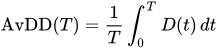
The average drawdown (AvDD) up to time  is the time average of drawdowns that have occurred up to time :
The maximum drawdown (MDD) up to time  is the maximum of the drawdown over the history of the variable. More formally, the MDD is defined as:

Trading definitions

There are two main definitions of a drawdown:

1. How low it goes (the magnitude)

Putting it plainly, a drawdown is the “pain” period experienced by an investor between a peak (new highs) and subsequent valley (a low point before moving higher).

Next, the Maximum Drawdown, or more commonly referred to as Max DD. This is pretty much self explanatory, as the Max DD is the worst (the maximum) peak to valley loss since the investment’s inception.

In finance, the use of the maximum drawdown as an indicator of risk is particularly popular in the world of commodity trading advisors through the widespread use of three performance measures: the Calmar ratio, the Sterling ratio and the Burke ratio. These measures can be considered as a modification of the Sharpe ratio in the sense that the numerator is always the excess of mean returns over the risk-free rate while the standard deviation of returns in the denominator is replaced by some function of the drawdown Read more...