Please don't forget to make a donation. We need your help in these difficult times. Donate now.

What is Mosaic theory ?

Source: Wikipedia
Mosaic theory, also referred to more colloquially as the scuttlebutt method by Philip Fisher in his seminal work Common Stocks and Uncommon Profits, in finance is the method used in security analysis to gather information about a corporation. Mosaic theory involves collecting information from different sources, public and private, to calculate the value of security. Applying the mosaic theory is as much art as it is science.[1] An analyst gleans as many pieces of information as possible, determines if they tell a story that makes sense, and decides whether to recommend a trade.
It is also a legal theory used uphold the classification of information, holding that a collection of unclassified information might add up into a classified whole. [2][3]

See also

References

  1. ^ "Mosaic Theory". Investopedia.com. http://www.investopedia.com/terms/m/mosaictheory.asp. Retrieved 07 December 2009. 
  2. ^ "Washington Post series: How many security secrets did it spill?", The Christian Science Monitor, Peter Grier, July 21, 2010
  3. ^ "The Mosaic Theory, National Security, and the Freedom of Information Act", 115 The Yale Law Journal 628, David E. Pozen, 2005

What is Consumer Confidence Index ?

Source: Wikipedia
The U.S. Consumer Confidence Index (CCI) is an indicator designed to measure consumer confidence, which is defined as the degree of optimism on the state of the economy that consumers are expressing through their activities of savings and spending. Global consumer confidence is not measured. Country by country analysis indicates huge variance around the globe. In an interconnected global economy, tracking international consumer confidence is a lead indicator of economic trends.[1]
In the United States consumer confidence is issued monthly by The Conference Board, an independent economic research organization, and is based on 5,000 households. Such measurement is indicative of consumption component level of the gross domestic product. The Federal Reserve looks at the CCI when determining interest rate changes, and it also affects stock market prices.
The Consumer Confidence Index was started in 1967 and is benchmarked to 1985=100. This year was chosen because it was neither a peak nor a trough. The Index is calculated each month on the basis of a household survey of consumers' opinions on current conditions and future expectations of the economy. Opinions on current conditions make up 40% of the index, with expectations of future conditions comprising the remaining 60%. In the glossary on its website, The Conference Board defines the Consumer Confidence Survey as "a monthly report detailing consumer attitudes and buying intentions, with data available by age, income and region".
Another well-established index that measures consumer confidence is the University of Michigan Consumer Sentiment Index, run by University of Michigan's Institute for Social Research.

Calculation

In simple terms, increased consumer confidence indicates economic growth in which consumers are spending money, indicating higher consumption. Decreasing consumer confidence implies slowing economic growth, and so consumers are likely to decrease their spending. The idea is that the more confident people feel about the economy and their jobs and incomes, the more likely they are to make purchases. Declining consumer confidence is a sign of slowing economic growth and may indicate that the economy is headed into trouble.
Each month The Conference Board surveys 5,000 U.S. households. The survey consists of five questions that ask the respondents' opinions about the following:[2]
  1. Current business conditions
  2. Business conditions for the next six months
  3. Current employment conditions
  4. Employment conditions for the next six months
  5. Total family income for the next six months
Survey participants are asked to answer each question as "positive", "negative" or "neutral". The preliminary results from the Consumer Confidence Survey are released on the last Tuesday of each month at 10am EST.
Once the data have been gathered, a proportion known as the "relative value" is calculated for each question separately. Each question's positive responses are divided by the sum of its positive and negative responses. The relative value for each question is then compared against each relative value from 1985. This comparison of the relative values results in an "index value" for each question.
The index values for all five questions are then averaged together to form the Consumer Confidence Index; the average of index values for questions one and three form the Present Situation Index, and the average of index values for questions two, four and five form the Expectations Index. The data are calculated for the United States as a whole and for each of the country's nine census regions.

How it is used

Manufacturers, retailers, banks and the government monitor changes in the CCI in order to factor in the data in their decision-making processes. While index changes of less than 5% are often dismissed as inconsequential, moves of 5% or more often indicate a change in the direction of the economy.
A month-on-month decreasing trend suggests consumers have a negative outlook on their ability to secure and retain good jobs. Thus, manufacturers may expect consumers to avoid retail purchases, particularly large-ticket items that require financing. Manufacturers may pare down inventories to reduce overhead and/or delay investing in new projects and facilities. Likewise, banks can anticipate a decrease in lending activity, mortgage applications and credit card use. When faced with a down-trending index, the government has a variety of options, such as issuing a tax rebate or taking other fiscal or monetary action to stimulate the economy.
Conversely, a rising trend in consumer confidence indicates improvements in consumer buying patterns. Manufacturers can increase production and hiring. Banks can expect increased demand for credit. Builders can prepare for a rise in home construction and government can anticipate improved tax revenues based on the increase in consumer spending.

Consumer Confidence Index in the United States

ConsumerConfidenceIndexUSA.png
The Conference Board Consumer Confidence Index is the most widely accepted index among the United States media, businesspeople, and many consumers.The chart to the left shows the index over time from June 1997 to January 2009.

Other measures of consumer confidence in the United States

In addition to the Conference Board's CCI, other survey-based indices attempt to track consumer confidence in the U.S.:
  • The University of Michigan Consumer Sentiment Index (MCSI) is a consumer confidence index published monthly by the University of Michigan. It uses an ongoing, nationally representative survey based on telephonic household interviews to gather information on consumer expectations regarding the overall economy.
  • The Washington Post-ABC News Consumer Comfort Index is a consumer confidence index based on telephone interviews with 1,000 randomly selected adults over the previous four-week period. It asks respondents "to rate the condition of the national economy, the state of their personal finances and whether now is a good time to buy things".
[3]
Given the potential for sampling biases of individual survey reports, researchers and investors try sometimes to average the values of different index reports into a single aggregated measure of consumer confidence.

Consumer Confidence Index in India

Original Article Indian consumer confidence index
Consumer confidence is a key driver of economic growth.  It is widely considered an economic indicator of household consumption expenditure. Consumers tend to increase consumption when they feel confident about the current and future economic situation of the country and their own financial situation. The relevance of such an index for a country like India is evident from the fact that Consumption Expenditure accounts for over 60% of India’s GDP.
The CNBC-TV18 Boston Analytics Consumer Confidence Index [1] is derived from a monthly survey of 10,000 targeted respondents across fifteen Indian cities—Delhi, Mumbai, Kolkata, Chennai, Hyderabad, Bangalore, Ahmedabad, Chandigarh, Nagpur, Kochi, Jaipur, Lucknow, Bhubaneswar, Patna, and Vishakhapatnam via face-to-face interviews. The sample aims at capturing the major contributors to the personal consumption component of the GDP.
The CNBC-TV18 Boston Analytics Consumer Confidence Index for June stands at 72.8, registering an increase of 2.5% from May’s reading of 71.0. The Current Situation Confidence Index increased by 2.1%, from 70.2 in May 2009 to 71.7 in June 2009. The Future Expectations Confidence Index also increased by 1.5%, from 72.3 in May 2009 to 73.3 in June 2009. However, the long term trend remains negative and the current bounce to 72.8 should not be viewed prematurely as a change in trend. The combination of improving economic outlook, improvement in pessimism about employment conditions, strength in optimism regarding household income and personal financial conditions along with a newly installed government promising economic reforms to stimulate the economy have led to a bounce in consumer confidence in June. However, the long term trend remains negative and the current bounce to 72.8 should not be viewed prematurely as a change in trend. It is important to note that we might have to observe a continuation of this bounce over several months before a change in trend can be declared. In particular, sentiment pertaining to consumer spending remains very weak.

Consumer confidence index in the Republic of Ireland

KBC Bank Ireland (formerly IIB Bank) and the Economic and Social Research Institute (a think-tank) have published a monthly consumer sentiment index since January 1996.[4]

Consumer confidence index in Canada

The Conference Board of Canada's Index of Consumer Confidence has been ongoing since 1980. It is constructed from responses to four attitudinal questions posed to a random sample of Canadian households. Those surveyed are asked to give their views about their households' current and expected financial positions and the short-term employment outlook. They are also asked to assess whether now is a good or a bad time to make a major purchase such as a house, car or other big-ticket items.

References

External links

What is Consumer price index ?

Source: Wikipedia
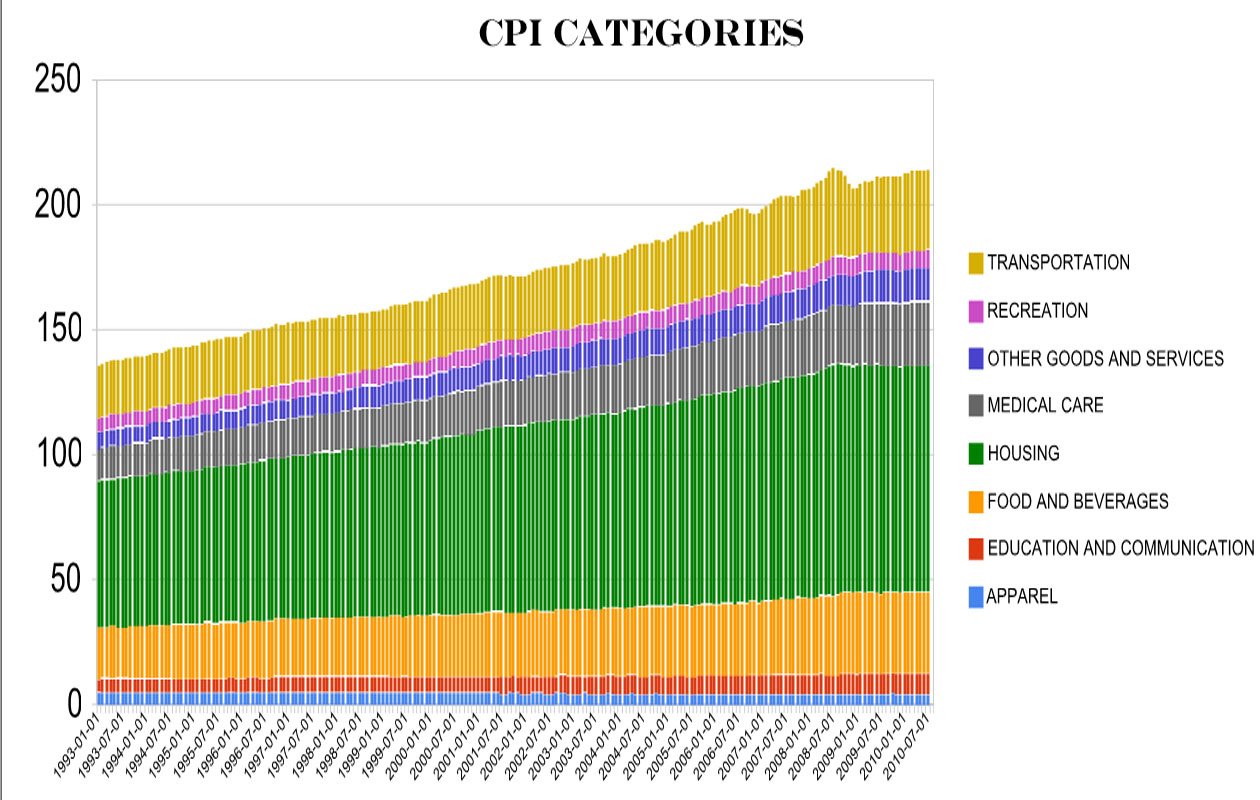
A consumer price index (CPI) measures changes through time in the price level of consumer goods and services purchased by households. The CPI is defined by the United States Bureau of Labor Statistics as "a measure of the average change over time in the prices paid by urban consumers for a market basket of consumer goods and services."[1]
The CPI is a statistical estimate constructed using the prices of a sample of representative items whose prices are collected periodically. Sub-indexes and sub-sub-indexes are computed for different categories and sub-categories of goods and services, being combined to produce the overall index with weights reflecting their shares in the total of the consumer expenditures covered by the index. It is one of several price indices calculated by most national statistical agencies. The annual percentage change in a CPI is used as a measure of inflation. A CPI can be used to index (i.e., adjust for the effect of inflation) the real value of wages, salaries, pensions, for regulating prices and for deflating monetary magnitudes to show changes in real values. In most countries, the CPI is, along with the population census and the USA National Income and Product Accounts, one of the most closely watched national economic statistics.

Introduction

Two basic types of data are needed to construct the CPI: price data and weighting data. The price data are collected for a sample of goods and services from a sample of sales outlets in a sample of locations for a sample of times. The weighting data are estimates of the shares of the different types of expenditure in the total expenditure covered by the index. These weights are usually based upon expenditure data obtained from expenditure surveys for a sample of households or upon estimates of the composition of consumption expenditure in the National Income and Product Accounts. Although some of the sampling of items for price collection is done using a sampling frame and probabilistic sampling methods, many items and outlets are chosen in a commonsense way (purposive sampling) that does not permit estimation of confidence intervals. Therefore, the sampling variance cannot be calculated. In any case, a single estimate is required in most of the purposes for which the index is used.
The index is usually computed monthly, or quarterly in some countries, as a weighted average of sub-indices for different components of consumer expenditure, such as food, housing, clothing, each of which is in turn a weighted average of sub-sub-indices. At the most detailed level, the elementary aggregate level, (for example, men's shirts sold in department stores in San Francisco), detailed weighting information is unavailable, so indices are computed using an unweighted arithmetic or geometric mean of the prices of the sampled product offers. (However, the growing use of scanner data is gradually making weighting information available even at the most detailed level.) These indices compare prices each month with prices in the price-reference month. The weights used to combine them into the higher-level aggregates, and then into the overall index, relate to the estimated expenditures during a preceding whole year of the consumers covered by the index on the products within its scope in the area covered. Thus the index is a fixed-weight index, but rarely a true Laspeyres index, since the weight-reference period of a year and the price-reference period, usually a more recent single month, do not coincide. It takes time to assemble and process the information used for weighting which, in addition to household expenditure surveys, may include trade and tax data.
Help end domestic violence today!
Ideally, the weights would relate to the composition of expenditure during the time between the price-reference month and the current month. There is a large technical economics literature on index formulae which would approximate this and which can be shown to approximate what economic theorists call a true cost of living index. Such an index would show how consumer expenditure would have to move to compensate for price changes so as to allow consumers to maintain a constant standard of living. Approximations can only be computed retrospectively, whereas the index has to appear monthly and, preferably, quite soon. Nevertheless, in some countries, notably in the United States and Sweden, the philosophy of the index is that it is inspired by and approximates the notion of a true cost of living (constant utility) index, whereas in most of Europe it is regarded more pragmatically.
The coverage of the index may be limited. Consumers' expenditure abroad is usually excluded; visitors' expenditure within the country may be excluded in principle if not in practice; the rural population may or may not be included; certain groups such as the very rich or the very poor may be excluded. Saving and investment are always excluded, though the prices paid for financial services provided by financial intermediaries may be included along with insurance.
The index reference period, usually called the base year, often differs both from the weight-reference period and the price reference period. This is just a matter of rescaling the whole time-series to make the value for the index reference-period equal to 100. Annually revised weights are a desirable but expensive feature of an index, for the older the weights the greater is the divergence between the current expenditure pattern and that of the weight reference-period.

Calculating the CPI for a single item

\frac{CPI_2}{CPI_1}= \frac{Price_2}{Price_1}
Where 1 is usually the comparison year and CPI1 is usually an index of 100.
Alternately, the CPI can be performed as CPI= \frac{\text{updated cost}}{\text{base period cost}} \times 100. The "updated cost" is the price of an item at a given year (say, the price of bread in 1982), divided by the initial year (the price of bread in 1970), multiplied by one hundred.[2]

Calculating the CPI for multiple items

Example: The prices of 95,000 items from 22,000 stores, and 35,000 rental units are added together and averaged. They are weighted this way: Housing: 41.4%, Food and Beverage: 17.4%, Transport: 17.0%, Medical Care: 6.9%, Other: 6.9%, Apparel: 6.0%, Entertainment: 4.4%. Taxes (43%) are not included in CPI computation.[3]
 CPI = \sum_{i=1}^{n} CPI_n * weight

Weighting

Weights and sub-indices

Weights can be expressed as fractions or ratios summing to one, as percentages summing to 100 or as per mille numbers summing to 1000.
In the European Union's Harmonised Index of Consumer Prices, for example, each country computes some 80 prescribed sub-indices, their weighted average constituting the national Harmonised Index. The weights for these sub-indices will consist of the sum of the weights of a number of component lower level indices. The classification is according to use, developed in a national accounting context. This is not necessarily the kind of classification that is most appropriate for a Consumer Price Index. Grouping together of substitutes or of products whose prices tend to move in parallel might be more suitable.
For some of these lower level indexes detailed reweighing to make them be available, allowing computations where the individual price observations can all be weighted. This may be the case, for example, where all selling is in the hands of a single national organisation which makes its data available to the index compilers. For most lower level indexes, however, the weight will consist of the sum of the weights of a number of elementary aggregate indexes, each weight corresponding to its fraction of the total annual expenditure covered by the index. An 'elementary aggregate' is a lowest-level component of expenditure, one which has a weight but within which, weights of its sub-components are usually lacking. Thus, for example: Weighted averages of elementary aggregate indexes (e.g. for men’s shirts, raincoats, women’s dresses etc.) make up low level indexes (e.g. Outer garments),
Weighted averages of these in turn provide sub-indices at a higher, more aggregated level,(e.g. clothing) and weighted averages of the latter provide yet more aggregated sub-indices (e.g. Clothing and Footwear).
Some of the elementary aggregate indexes, and some of the sub-indexes can be defined simply in terms of the types of goods and/or services they cover, as in the case of such products as newspapers in some countries and postal services, which have nationally uniform prices. But where price movements do differ or might differ between regions or between outlet types, separate regional and/or outlet-type elementary aggregates are ideally required for each detailed category of goods and services, each with its own weight. An example might be an elementary aggregate for sliced bread sold in supermarkets in the Northern region.
Most elementary aggregate indexes are necessarily 'unweighted' averages for the sample of products within the sampled outlets. However in cases where it is possible to select the sample of outlets from which prices are collected so as to reflect the shares of sales to consumers of the different outlet types covered, self-weighted elementary aggregate indexes may be computed. Similarly, if the market shares of the different types of product represented by product types are known, even only approximately, the number of observed products to be priced for each of them can be made proportional to those shares.
Quality unisex jewelry

Estimating weights

The outlet and regional dimensions noted above mean that the estimation of weights involves a lot more than just the breakdown of expenditure by types of goods and services, and the number of separately weighted indexes composing the overall index depends upon two factors:
  1. The degree of detail to which available data permit breakdown of total consumption expenditure in the weight reference-period by type of expenditure, region and outlet type.
  2. Whether there is reason to believe that price movements vary between these most detailed categories.
How the weights are calculated, and in how much detail, depends upon the availability of information and upon the scope of the index. In the UK the RPI does not relate to the whole of consumption, for the reference population is all private households with the exception of a) pensioner households that derive at least three-quarters of their total income from state pensions and benefits and b) "high income households" whose total household income lies within the top four per cent of all households. The result is that it is difficult to use data sources relating to total consumption by all population groups.
For products whose price movements can differ between regions and between different types of outlet:
  • The ideal, rarely realisable in practice, would consist of estimates of expenditure for each detailed consumption category, for each type of outlet, for each region.
  • At the opposite extreme, with no regional data on expenditure totals but only on population (e.g. 24% in the Northern region) and only national estimates for the shares of different outlet types for broad categories of consumption (e.g. 70% of food sold in supermarkets) the weight for sliced bread sold in supermarkets in the Northern region has to be estimated as the share of sliced bread in total consumption × 0.24 × 0.7.
The situation in most countries comes somewhere between these two extremes. The point is to make the best use of whatever data are available.

The nature of the data used for weighting

No firm rules can be suggested on this issue for the simple reason that the available statistical sources differ between countries. However, all countries conduct periodical Household Expenditure surveys and all produce breakdowns of Consumption Expenditure in their National Accounts. The expenditure classifications used there may however be different. In particular:
  • Household Expenditure surveys do not cover the expenditures of foreign visitors, though these may be within the scope of a Consumer Price Index.
  • National Accounts include imputed rents for owner-occupied dwellings which may not be within the scope of a Consumer Price Index.
Even with the necessary adjustments, the National Account estimates and Household Expenditure Surveys usually diverge.
The statistical sources required for regional and outlet-type breakdowns are usually weaker. Only a large-sample Household Expenditure survey can provide a regional breakdown. Regional population data are sometimes used for this purpose, but need adjustment to allow for regional differences in living standards and consumption patterns. Statistics of retail sales and market research reports can provide information for estimating outlet-type breakdowns, but the classifications they use rarely correspond to COICOP categories.
The increasingly widespread use of bar codes, scanners in shops has meant that detailed cash register printed receipts are provided by shops for an increasing share of retail purchases. This development makes possible improved Household Expenditure surveys, as Statistics Iceland has demonstrated. Survey respondents keeping a diary of their purchases need to record only the total of purchases when itemised receipts were given to them and keep these receipts in a special pocket in the diary. These receipts provide not only a detailed breakdown of purchases but also the name of the outlet. Thus response burden is markedly reduced, accuracy is increased, product description is more specific and point of purchase data are obtained, facilitating the estimation of outlet-type weights.
There are only two general principles for the estimation of weights: use all the available information and accept that rough estimates are better than no estimates.

Reweighing

Ideally, in computing an index, the weights would represent current annual expenditure patterns. In practice they necessarily reflect past expenditure patterns, using the most recent data available or, if they are not of high quality, some average of the data for more than one previous year. Some countries have used a three-year average in recognition of the fact that household survey estimates are of poor quality. In some cases some of the data sources used may not be available annually, in which case some of the weights for lower level aggregates within higher level aggregates are based on older data than the higher level weights.
Infrequent reweighing saves costs for the national statistical office but delays the introduction into the index of new types of expenditure. For example, subscriptions for Internet Service entered index compilation with a considerable time lag in some countries, and account could be taken of digital camera prices between re-weightings only by including some digital cameras in the same elementary aggregate as film cameras.

Owner-occupiers and the price index

The way in which owner-occupied dwellings should be dealt with in a Consumer Price Index has been, and remains, a subject of heated controversy in many countries. The purpose of this entry is to explain why.

The economists' approach

Leaving aside the quality of public services, the environment, crime and so forth, and regarding the standard of living as a function of the level and composition of individuals’ consumption, this standard depends upon the amount and range of goods and services they consume. These include the service provided by rented accommodation, which can readily be priced, and the similar services yielded by a flat or house owned by the consumer who occupies it. Its cost to a consumer is, according to the economic way of thinking, an “opportunity cost”, namely what he or she sacrifices by living in it. This cost, according to many economists, is what should form a component of a Consumer Price Index. Opportunity cost can be looked at in two ways, since there are two alternatives to continuing to live in an owner-occupied dwelling. One — supposing that it is one year’s cost that is to be considered — is to sell it, earn interest on the owner’s capital thus released, and buy it back a year later, making an allowance for its physical depreciation. This can be called the “alternative cost” approach. The other, the “rental equivalent” approach, is to let it to someone else for the year, in which case the cost is the rent that could be obtained for it. Most people do not think about their dwelling in either of these ways, but this does not bother the theoretical economist for whom consistent logic is what matters. There are, of course, practical problems in implementing either of these economists’ approaches. Thus, with the alternative cost approach, if house prices are rising fast the cost can be negative and then become sharply positive once house prices start to fall, so such an index would be very volatile. On the other hand, with the rental equivalent approach, there may be difficulty in estimating the movement of rental values of types of property which are not actually rented. If one or other of these measures of the consumption of the services of owner-occupied dwellings is included in consumption, then it must be included in income too, for income equals consumption plus saving. This means that if the movement of incomes is to be compared with the movement of the Consumer Price Index, incomes must be expressed as money income plus this imaginary consumption value. That is logical, but it may not be what users of the index want. Although the argument has been expressed in connection with owner-occupied dwellings, the logic applies equally to all durable consumer goods and services. Furniture, carpets and domestic appliances are not used up soon after purchase in the way that food is. Like dwellings, they yield a consumption service that can continue for years. Furthermore, since strict logic is to be adhered to, there are durable services as well that ought to be treated in the same way; the service consumers derive from appendectomies or crowned teeth continue for a long time. Since estimating values for these components of consumption has not been tackled, the economic theorists are torn between their desire for intellectual consistency and their recognition that inclusion of the opportunity cost of the use of durables is impracticable.

Spending

Another approach is to concentrate on spending.[3] Everyone agrees that repairs and maintenance expenditure of owner-occupied dwellings should be covered in a Consumer Price Index, but the spending approach would include mortgage interest too. This turns out to be quite complicated, conceptually as well as in practice. To explain what is involved, consider a Consumer Price Index computed with reference to 2009 for just one sole consumer who bought her house in 2006, financing half of this sum by raising a mortgage. The problem is to compare how much interest such a consumer would now be paying with the interest that was paid in 2009. Since the aim is to compare like with like, that requires an estimate of how much interest would be paid now in the year 2010 on a similar house bought and 50% mortgage-financed three years ago, in 2007. It does not require an estimate of how much that identical person is paying now on the actual house she bought in 2006, even though that is what personally concerns her now. A Consumer Price Index compares how much it would cost now to do exactly what consumers did in the reference-period with what it cost then. Application of the principle thus requires that the index for our one house owner should reflect the movement of the prices of houses like hers from 2006 to 2007 and the change in interest rates. If she took out a fixed-interest rate mortgage it is the change in interest rates from 2006 to 2007 that counts; if she took out a variable interest mortgage it is the change from 2009 to 2010 that counts. Thus her current index with 1999 as reference-period will stand at more than 100 if house prices or, in the case of a fixed-interest mortgage, interest rates rose between 2006 and 2007. The application of this principle in the owner-occupied dwellings component of a Consumer Price Index is known as the “debt profile” method. It means that the current movement of the index will reflect past changes in dwelling prices and interest rates. Some people regard this as odd. Quite a few countries use the debt profile method, but in doing so most of them behave inconsistently. Consistency would require that the index should also cover the interest on consumer credit instead of the whole price paid for the products bought on credit if it covers mortgage interest payments. Products bought on credit would then be treated in the same way as owner-occupied dwellings. Variants of the debt profile method are employed or have been proposed. One example is to include down payments as well as interest. Another is to correct nominal mortgage rates for changes in dwelling prices or for changes in the rest of the Consumer Price Index to obtain a “real” rate of interest. Also, other methods may be used alongside the debt profile method. Thus several countries include a purely notional cost of depreciation as an additional index component, applying an arbitrarily estimated, or rather guessed, depreciation rate to the value of the stock of owner-occupied dwellings. Finally, one country includes both mortgage interest and purchase prices in its index.

Transaction prices

The third approach simply treats the acquisition of owner-occupied dwellings in the same way as acquisitions of other durable products are treated. This means: Taking account of the transaction prices agreed;
  • Ignoring whether payments are delayed or are partly financed by borrowing;
  • Leaving out second-hand transactions. Second-hand purchases correspond to sales by other consumers. Thus only new dwellings would be included.
Furthermore, expenditure on enlarging or reconstructing an owner-occupied dwelling would be covered, in addition to regular maintenance and repair. Two arguments of an almost theological character are advanced in connection with this transactions approach. One is that purchases of new dwellings are treated as Investment in the System of National Accounts, so should not enter a consumption price index. It is said that this is more than just a matter of terminological uniformity. For example it may be thought to help understanding and facilitate economic analysis if what is included under the heading of Consumption is the same in the Consumer Price Index and in the national income and expenditure accounts. Since these accounts include the equivalent rental value of owner-occupied dwellings, the equivalent rental approach would have to be applied in the Consumer Price Index too. But the national accounts do not apply it to other durables, so the argument demands consistency in one respect but accepts its rejection in another. The other argument is that the prices of new dwellings should exclude that part reflecting the value of the land, since this is an irreproducible and permanent asset that cannot be said to be consumed. This would presumably mean deducting site value from the price of a dwelling, site value presumably being defined as the price the site would fetch at auction if the dwelling were not on it. How this is to be understood in the case of multiple dwellings remains unclear.

Confusion

It is apparent that much of the muddle in discussing the merits of the different approaches arises from the promiscuous mixing up of arguments about feasibility, about dislike or approval of the way the index would move under a particular approach and about principles of various, often incompatible, sorts. Feasibility is naturally important. The difficulty of dealing with site values is obvious. The statisticians in a country lacking a good dwelling price index (which is required for all except the rental equivalent method) will only go along with a proposal to use such an index if they can obtain the necessary additional resources that will enable them to compile one. Even obtaining mortgage interest rate data can be a major task in a country with a multitude of mortgage lenders and many types of mortgage. Dislike of the effect upon the behaviour of the Consumer Price Index arising from the adoption of some methods can be a powerful, if sometimes unprincipled, argument. Dwelling prices are volatile and so, therefore, would be an index incorporating the current value of a dwelling price sub-index which, in some countries, would have a large weight under the third approach. Furthermore, the weight for owner-occupied dwellings could be altered considerably when reweighting was undertaken. (It could even become negative under the alternative cost approach if weights were estimated for a year during which house prices had been rising steeply). Then there is the point that a rise in interest rates designed to halt inflation could paradoxically make inflation appear higher if current interest rates showed up in the index. The economists’ principles are not acceptable to all; nor is insistence upon consistency between the treatment of owner-occupied dwellings and other durables.

Clarity

Much would be gained if two sets of problems were distinguished.*
  • What is the Consumer Price Index to measure?
  • How can that be achieved?
Another way of putting this is to distinguish:
  • What is the question that should be answered? This is a matter for policy makers and other users of the Consumer Price Index.
  • How can it best be answered? This is a matter for the statisticians.#
The three approaches should not be regarded as rivals, they are different answers to different questions. One, or possibly more, should be chosen. The three questions can be formulated as follows:
  1. Opportunity cost. What is the change through time in what would be the opportunity cost of the reference-period consumption of the services of owner-occupied dwellings?
  2. Spending. What is the change through time in the cash outlays that would correspond to the reference-period cash outlays in respect of owner-occupied dwellings?
  3. Transactions. What is the change through time in what would be the purchase value of the reference-period net acquisition of owner-occupied dwellings by consumers?
Which question is to be answered is, as just stated, a policy matter, depending upon the purposes the index is to serve. It is not an issue for statisticians to decide. Their job is the technical, professional one of compiling one or more indexes that answer the selected question or questions as well as possible, given the resources at their disposal. In a perfect world this is how the owner-occupied dwellings issue would be resolved. But the world is not perfect.

History

Between 1971 and 1977, the United States CPI increased 47%.[4]
In 2009, the Consumer Price Index fell for the first time since 1955.[5]

See also

References

  1. ^ "Consumer Price Index - Frequently Asked Questions (FAQs)". Bureau of Labor Statistics. Accessed September 10, 2010. http://www.bls.gov/cpi/cpifaq.htm. 
  2. ^ Education 2020 Homeschool Console, subject Economics, lecture "Inflation". Formula described within.
  3. ^ Bloomberg Business News, Social Security Administration
  4. ^ Frum, David (2000). How We Got Here: The '70s. New York, New York: Basic Books. p. 324. ISBN 0465041957. 
  5. ^ Harper's Magazine http://harpers.org/archive/2009/04/WeeklyReview2009-04-21

External links

  • ILO CPI manual This large manual produced co-operatively by a number of international organizations is the standard work on the methods of compiling consumer price indexes and on the underlying economic and statistical theory.
  • myCPI.info Project for establishing alternative CPI data based on users inputting and tracking their personal CPI.
  • "The Consumer Price Index and index number purpose": A technical article by economist W.E. Diewert
  • [1] Bureau of Labor Statistics - Consumer Price Index (CPI)
Specific countries

American Consumer Confidence is coming back

Source: Bloomberg Business Week
Conspicuous Consumption Is Back
Subdued fashions of the recession years are fading as wealthy Americans again flaunt luxury purchases
By Ben Steverman
Rich Americans are not only shopping again. They're showing off their purchases, despite an economy that still leaves millions of people jobless and underemployed.

"It's not polite to flaunt money when your friends are out of work," says Erika Maschmeyer, an analyst of retail stocks at Robert W. Baird in Chicago. Now, though, "we're far enough away from the disaster of 2008. We're back to normal fashion cycles."

While the U.S. unemployment rate remains high at 9.4 percent, the past two years have benefited Americans who primarily rely on income from investments rather than their jobs. The broad Standard & Poor's 500 stock index is up 61 percent since its March 2009 low and now trades above its level before the collapse of Lehman Brothers.

Luxury retailers did lose customers who couldn't really afford expensive products in the first place. With their access to credit restricted, two-thirds of so-called aspirational shoppers stopped buying luxuries in the recession, according to data from American Express Business Insights. Just a quarter of wealthy luxury customers stopped shopping, and many have been replaced by new, younger shoppers.
Luxury at Online Discounts

"The younger generations continue to spend as if nothing happened," says Ed Jay, senior vice-president at American Express Business Insights, which says 36 percent of luxury spending is now done by shoppers who were not buying high-end brands before the recession. About a third of these new shoppers are from Generation X, and 10 percent are from Generation Y. These prosperous young consumers have embraced luxury shopping through increasingly popular discount fashion websites, Jay says. Gilt Groupe is a prominent example.

Certain marquee forms of conspicuous consumption never really went away. In a forthcoming paper in the Journal of Consumer Psychology, Joseph Nunes, marketing professor at the University of Southern California Marshall School of Business, and two colleagues studied shifts in the styles of Louis Vuitton and Gucci handbags marketed in the U.S. before and during the recession. The study rated purses on the prominence of the logos that advertise the bag's pricey brands.

"Everybody was saying, 'the age of the conspicuous consumer is dead,'" says Nunes, so one might expect logos to shrink and brand identities to be more subtle. In fact, both companies "turned up" the prominence of their brands from January 2008 to May 2009, the researchers concluded. The study also examined the prominence of logos in advertising for other luxury handbag makers and found that none toned down their ads. One—Burberry—emphasized its brand further.
Grasping for Status

Handbags were studied because they are "the quintessential luxury good for women," a key way to flaunt an owner's status everywhere she goes, says Nunes. Handbag manufacturers are careful to reflect consumer demand, so why didn't they make less ostentatious bags during the recession? "A good chunk of America loves using products to signal their status," Nunes says. "If the recession didn't hit them"—and thus they could still afford to shop—"their need for status outweighed their need to follow social norms." A spokesperson for Louis Vuitton declined to comment; a phone call and an e-mail to Gucci were not returned.

After a 2010 holiday season that favored luxury retailers, the stigma against conspicuous luxury seems to be fading further, says Sherif Mityas, a partner in the retail practice at management consulting firm A.T. Kearney. For those who can afford it, "it's en vogue to spend money," he says. "They don't need to hide their luxury anymore."

For several years, women's fashion has been dominated by dark, subdued colors. "Personally, I'm over the gray and black," says Sapna Shah, principal at research firm Retail Eye Partners. Early indications are that 2011 collections will look different—more upbeat and prosperous. "Going into Spring, there is a lot of color and a lot of novelty," she says. "Nothing feels like it's dumbed down because of the economy."

Anxiety about the economy did drive some rich consumers to cut back, even when they could afford to spend. Yet much of their frugality was symbolic, says Harvey Hartman, founder of the Hartman Group, a consumer research firm. They would "try to cut one thing, but they'll spend more somewhere else," he says.
Don't Forget the Wannabes
Single and looking. Email me.

With their wealthy clients shopping again, the next challenge for luxury brands will be luring back aspirational shoppers who gain enough confidence from an improving economy, Mityas says. That might result in even more products with prominent luxury logos. "The brand is as important as the product for that group," he says.

Apparel and accessories aren't the only forms of conspicuous consumption. Even as the economy was mired in recession, consumers of all income levels stretched to afford expensive electronics, says Michael McNamara, vice-president for research and analysis at MasterCard Advisors SpendingPulse. The definition of luxury is expanding, he says, to include these products, such as high-end televisions or the $499-to-$829 iPad made by Apple (AAPL).

Maybe it was never very realistic to think that well-heeled American shoppers were going to embrace a thrifty, frugal lifestyle. "It's like telling the consumer: You're not going to have fun anymore," Hartman says. As Americans, he says, "We're just not like that."

Steverman is a reporter for Bloomberg News.

Is Facebook really worth $50 Billion ?

Source: Business Week
Facebook Overvalued at $50 Billion in Global Poll of Investors
January 28, 2011, 11:07 AM EST
By Alison Fitzgerald
Jan. 28 (Bloomberg) -- Facebook Inc. isn’t worth $50 billion, according to a poll of global investors that shows skepticism about Goldman Sachs Group Inc.’s recent estimate of the largest social-networking site’s value and concern that a bubble may be forming in the technology sector.

Sixty-nine percent of investors say Facebook is overvalued after Goldman Sachs invested $450 million in a deal that put the company’s worth at $50 billion, according to the quarterly poll of 1,000 Bloomberg customers who are investors, traders or analysts. Only 10 percent of respondents say Facebook’s valuation is appropriate; 4 percent say it’s worth more.

The Bloomberg Global Poll conducted Jan. 21-24 shows that investors disagree with Goldman Sachs’ assessment that Facebook is worth more than Web pioneers such as Yahoo! Inc., the biggest web portal, and eBay Inc., owner of the biggest online retail marketplace. Palo Alto, California-based Facebook surpassed Yahoo! in October as the third most visited website in the world.

“Those investing in Facebook, expecting it to be the next Google, might be in for some bad news along the way,” says poll respondent John J. Lee, a portfolio manager at PGB Trust & Investments in Morristown, New Jersey. Mountain View, California-based Google went public in August 2004 and the shares more than tripled in the first year to $279.99 from $85. The stock price averaged $617.2 this month.

‘Cheaper Copycat Lookalikes’

“Eventually, all fads get cheaper copycat lookalikes,” he says. “While being first to market makes Facebook a winner, another faster, stronger company with more something will come along and dilute its value.” Lee says his firm owns Google shares in some portfolios.

Facebook raised $1.5 billion in a Goldman Sachs-led financing round this month. In addition to Goldman Sachs’ $450 million investment, Russia-based Digital Sky Technologies put up $50 million and Goldman Sachs clients outside the U.S. snapped up a $1 billion stake in the company. Goldman Sachs, which retained the right to sell $75 million of its stake to Digital Sky, had originally offered Facebook shares to its U.S. clients in a private placement. That was called off after details became public because the offering risked running afoul of U.S. securities laws.

Stephen Cohen, a spokesman for New York-based Goldman Sachs, declined to comment. A Facebook spokesman, Jonathan Thaw, declined to discuss the valuation. “We’re focused on creating a useful service and building our business for the long term,” he said in an e-mailed statement.

‘Dangerous New Bubble’

The Bloomberg poll shows that the Facebook deal has made investors uneasy about internet companies in general. More than half the respondents say the firm’s valuation signals the “beginning of a dangerous new bubble” in the market, while only 17 percent saw it as the foundation of a lasting boom.

“More than a bubble, Facebook is a manifestation of the rational excesses that only the financial markets are capable of when confronted with something without precedents and more importantly unexpected,” said Luigi La Ferla, co-founder of LTP Trade Ltd. in London. ‘

Investors worldwide have doubts about the Facebook deal, and those outside the U.S. were most pessimistic. Seventy-two percent of non-U.S. respondents say the company was overvalued. Among U.S. investors that number is 63 percent.

“There’s too little financial information and track history to value the company like this,” says La Ferla. ‘Besides, you do not want to buy any of Goldman’s proprietary positions that they’re willing to sell.”

China’s Tencent

The $50 billion valuation puts Facebook in league with publicly traded Tencent Holdings Ltd. The Shenzhen, China-based internet company, whose services include online games and instant messaging, is worth more than $42 billion on the Hong Kong stock exchange. Tencent trades at about 15 times revenue. The Facebook valuation is about 25 times its 2010 revenue. Google’s price-to-sales ratio is 9, analysts estimate. EBay’s market value is $40.5 billion and Yahoo!’s is $21.2 billion.

LinkedIn Corp., a Mountain View, California-based professional networking firm, filed yesterday with the Securities and Exchange Commission to raise as much as much as $175 million in an initial public offering. The company is valued at $2.5 billion on SharesPost Inc., a San Bruno, California-based online marketplace for trading shares in private companies.

‘Lasting Boom’

Among European investors in the poll, 56 percent say the Facebook deal signals a bubble among online firms, while less than half of U.S.-based respondents agree. About a quarter of Asian investors see the deal as the start of a new boom in online companies, while overall 17 percent of those polled are positive.

“The current uptrend in e-commerce companies is a lasting boom, with or without Facebook,” says poll respondent Henry Littig, owner of Henry Littig Global Investments AG in Cologne, Germany.
Single and looking. Email me.

In 2008, Mark Zuckerberg, Facebook’s founder and chief executive officer, became the world’s youngest billionaire at 23 when Forbes Magazine listed his wealth at $1.5 billion. The magazine now says his net worth has reached $6.9 billion. Zuckerberg is the central character in the hit movie “The Social Network,” about the founding of Facebook, which was nominated for eight Academy Awards this month.

500 Million Members

Facebook’s social network has more than 500 million members and trails only Google and Microsoft Corp. as the world’s most visited website, according to ComScore Inc.

The company had revenue of $1.2 billion in the first three quarters of last year, up from $777 million, according to a person who had viewed documents sent to potential investors by Goldman Sachs. The company reported profit of $355 million in the first three quarters of last year, compared with profit of more than $200 million for all of 2009.

The poll was conducted by Des Moines, Iowa-based Selzer & Co. for Bloomberg and has a margin of error of plus or minus 3.1 percentage points.

--Editors: Max Berley, Mark McQuillan.

Income disparity in China explained

Source: Bloomberg
China's Growing Income Gap
By Dexter Roberts
Billions in unreported income for the wealthy and a system that blocks health and pension benefits for migrants mean the income gap is wider than acknowledged
It takes about three hours by bus from the glitzy malls of central Beijing to reach Yongfengtun, a farming village northwest of the capital that has quadrupled in population, to 20,000, over the past few years. Here one finds a gritty version of a Chinese bedroom community. Grimy storefronts advertise cheap clothing, shoes, and budget mobile-phone service. Mangy dogs root through piles of trash on the bicycle- and pedestrian-crowded streets.

Yongfengtun's streets may be rundown, yet they attract thousands of migrant workers and the so-called ant tribe (cash-strapped urban youth) from across all China. "It's cheap!" says one 23-year-old, a recent college graduate who pays $39 a month for a 65-square-foot apartment. "Heat costs money," he says ruefully as he kicks a pan of water for washing laundry that has frozen solid. "There is no way I could afford an apartment in central Beijing," with rents probably 10 times higher for a comparable place, he says.

It's not as if incomes are stagnant in China—anything but. In the first half of 2010 per capita income rose 13 percent in the countryside, to $935 a year, and 10 percent in the cities, to $2,965 a year. Nevertheless, swelling slums in the suburbs of Beijing, Shanghai, and Guangzhou attest to a yawning wealth discrepancy between thousands of newly minted rich and millions of poor.

China already is showing levels of inequality comparable to the Philippines and Russia and is far less egalitarian than Japan, the U.S., and even Eastern Europe, according to Li Shi, an authority on income distribution trends at Beijing Normal University. Official figures show rural incomes are less than one-third those in cities, with the top 10 percent of urban Chinese earning about 23 times that of the poorest 10 percent—a ratio that is almost certainly understated, according to Li. "You can find increasing income inequality almost everywhere in China today," he says.

One reason is a system that blocks an estimated 150 million or more rural migrant workers from gaining access to benefits such as health care, education, and pensions available to urban residents. As a result, migrants are forced to save more of their wages to cover medical expenses and their retirements, says Li. Their incomes are also getting pinched by higher food prices (inflation is hovering around 5 percent) and rising housing prices (up 6.4 percent in December on an annual basis).

China's Gini coefficient, an income distribution gauge used by economists, worsened from below 0.3 a quarter-century ago to near 0.5 today, says Li. (The measure, named after Italian statistician Corrado Gini, ranges from 0 to 1.) Poverty researchers recognize anything above 0.4 as potentially socially destabilizing.

China's wealth gap may be worse than official statistics indicate. The incomes of better-off families are understated, says Wang Xiaolu, an economist at the independent National Economic Research Institute in Beijing.

Undisclosed income, which Wang says could add up to $1.4 trillion annually, ranges from kickbacks to businesses or government to perks such as subsidized housing offered by state-run companies. If so, the wealthiest 10 percent of the population earned 65 times that of poorest 10 percent—not the 23 times shown by government data.

President Hu Jintao's government is keenly aware of the problem. Policies aimed at lifting incomes include the 2006 abolishment of the agricultural tax, new central and local government mandates to fund nine years of free education, improved health care, and the construction of low-income housing.

Single and looking. Email me.

Further narrowing of the income gap will require changes in fiscal policy, says Louis Kuijs, a World Bank economist in Beijing. Expanding government revenues beyond taxes on wages to include levies on property, as well as on income earned from capital gains on real estate and stocks, is one step, say Kuijs and economist Wang. Continued reform of China's household registration system, to allow migrants more access to social welfare benefits, is also necessary. A survey done last September by Horizon Research Consultancy Group, a Beijing researcher, showed a drop in life satisfaction and declining confidence about China's future, despite the country's double-digit growth rates. With food and housing prices rising, "people feel their quality of life has gone down," says Victor Yuan, founder and chairman of Horizon.

The bottom line: The gap between rich and poor in China is wider than generally realized and could create political problems for Beijing.

Roberts is Bloomberg Businessweek's Asia News Editor and China bureau chief.

Best entry level jobs in 2011

Source: bnet.com
Hot Entry-Level Jobs for 2011 and How to Get Them
By Jessica Stillman | January 27, 2011
The labor market at the moment is anything but hot — in fact expressions like ‘on ice’ and ‘barely alive’ seem more apt — but even dreary situations have bright spots. You just have to look really, really hard. Which is what online training company mindflash.com has done, crunching BLS data along with info from Payscale.com and other sources to find the ten most in-demand jobs in the U.S. in 2011.

Everything under $10
Mindflash also appears to understand that finding shelter in these fast-growing professions is often easier said than done without the right training or experience, so their list also explains what skills and qualifications are needed to actually land one of these gigs. For young people still choosing their direction or older workers in search of a new career path, these jobs are worth considering:

* Mobile Applications Developer. Training required: bachelor’s degree preferred; programming experience in top mobile platforms, including Java ME, Symbian, iOS, and others.
* Biomedical Engineer. Training required: license required in all states if you offer public services. Requires a degree from an ABET-accredited engineering program, four years of relevant work experience, and passing a state exam.
* Home Health Aid. Training required: to work for agencies that receive Medicare or Medicaid reimbursement, aides must receive formal training and pass a competency test.
* Physician Assistant. Training required: Accredited PA training program (up to two years); Become PA certified (optional) by passing the Physician Assistant National Certification Examination.
* Software Engineer: Training required: bachelor’s degree preferred; programming experience in popular languages like Java, C/C++, PHP, Python, etc.
* Environmental Engineer. Training required: license required in all states is you offer public services. Requires a degree from an ABET-accredited engineering program, four years of relevant work experience, and passing a state exam.
* HVAC Technician. Training required: six months to two years of vocational career training from accrediting agencies, such as HVAC Excellence.
* Financial Analyst. Training required: bachelor’s degree preferred; master’s degree required for some positions; licensure depends on sector.
* Medical Records Technician. Training required: associate’s degree; Registered Health Information Technicians (RHIT) credential (preferred).
* Elementary School Teacher. Training required: bachelor’s degree with teaching credential.

For more information on the gigs, including starting salaries (which range from $21,620 to $102,500), projected hiring growth, key skills and information on who’s hiring, check out the complete infographic.

And if you’re children or engineering-phobic or unhappy with the starting salaries on offer in the Mindflash list, there are other options. AOL Jobs and PayScale.com have also teamed up to compile a list of high-paying entry-level jobs. These will all start you out on at least $40,000 a year, but again they may require significant training and, unlike the Mindflash list are not all necessarily boom industries:

* Investment Banking Analyst
* Assistant Actuarial Analyst
* Junior Tax Associate
* Pharmaceutical Sales Representative
* Auditor
* Wind Turbine Technician
* Health Care Research Analyst
* Search Engine Optimization (SEO) Analyst
* Forensic DNA Analyst
* Law Research Associate